Diapause and Developmental Arrest as Drivers of Population Resilience Through Stress

Diapause and Developmental Arrest as Drivers of Population Resilience Through Stress
Baur, G.; Bone, E.; Moore, H.; Elliott, L.; Ham, A.; Ripper, M.; Scharf, A.
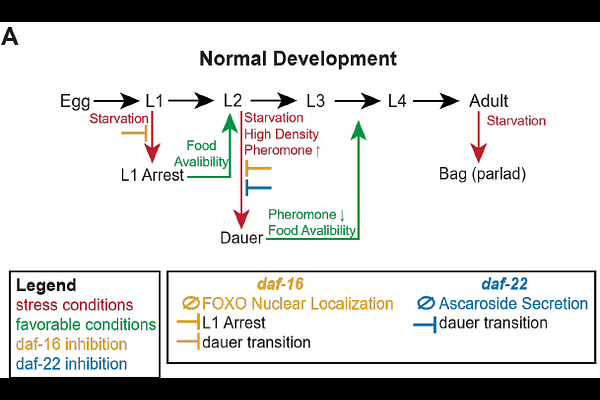
AbstractDauer formation and L1 arrest are stress-responsive developmental strategies that enable Caenorhabditis elegans to survive unfavorable conditions. These responses are regulated by environmental cues, including food availability and pheromone signals that communicate population density. However, how dauer entry, L1 arrest, and density-dependent signaling collectively influence long-term population dynamics remains poorly understood. In this study, populations of daf-22 and daf-16 mutants with impaired dauer formation, starvation arrest, and pheromone signaling were compared under control and starvation stress. Measurements of developmental stages were used to evaluate how genotype influenced population growth, developmental stage composition, starvation response, and recovery over time. This population-level approach links individual developmental decisions and inter-organismal communication to broader patterns of persistence and population change. The results show that daf-16 and daf-22 mutant populations differed from wild type in their recovery ability following nutrient deprivation as well as in the stage distributions within the population. These findings suggest that dauer signaling contributes broadly to population persistence by coordinating developmental arrest, reproduction, survival, and recovery. Overall, this work supports the interpretation of dauer formation as a larger population level survival program rather than a single isolated developmental outcome.