Hormonally responsive bovine oviductal organoids recapitulate native oviductal secretions and enhance sperm capacitation

Hormonally responsive bovine oviductal organoids recapitulate native oviductal secretions and enhance sperm capacitation
Navarro-Serna, S.; Romero-Aguirregomezcorta, J.; Hernandez-Diaz, N.; Ferrero-Mico, A.; Coy, P.; Perez-Garcia, V.
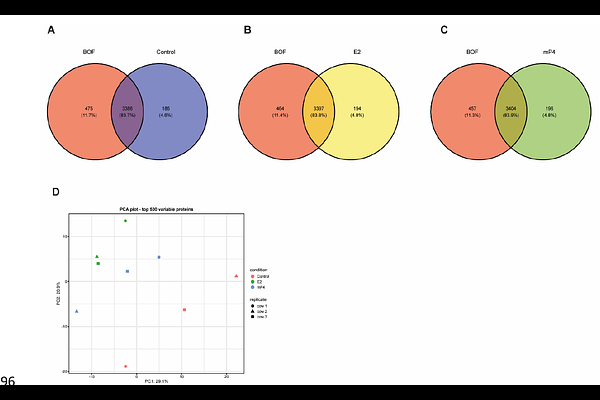
AbstractThe oviduct provides the dynamic microenvironment that supports fertilization and early embryo development yet replicating its hormonally regulated secretory activity in vitro remains a major challenge. Here, we established bovine oviductal epithelial organoids that reproduce the structural polarity and endocrine responsiveness of the native oviduct. Exposure to either estradiol or progesterone resulted in distinct transcriptomic and proteomic landscapes that were characteristic of the follicular and luteal phases, respectively. This included the upregulation of canonical phase-specific markers, such as OVGP1, NTS, HP and TGM2. Proteomic profiling of organoid-derived secretions (ODS) revealed extensive overlap with in vivo oviductal fluid. Integration of transcriptomic and proteomic datasets by multi-omics factor analysis identified coherent biological signatures defining each hormonal state. Functionally, ODS obtained from estradiol-treated organoids enhanced sperm capacitation and acrosome reaction, recapitulating the activity of follicular-phase oviductal fluid. These findings demonstrate that hormonally responsive oviductal organoids generate bioactive secretions that emulate the molecular and functional features of the native oviductal environment, providing a sustainable and physiologically relevant platform for studying gamete-maternal communication and improving assisted reproduction technologies.