Investigating the landscape of plant-pollinator interactions in a hybrid zone

Investigating the landscape of plant-pollinator interactions in a hybrid zone
Engle-Wrye, N. J.; Carril, O. M.; Mohottige, C. G.; Mlsna, T. E.; Folk, R. A.
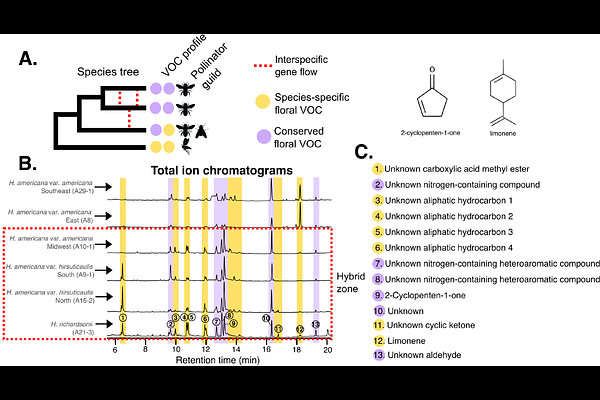
AbstractLittle is known about environmental drivers of opportunities for hybridization, but its phylogenetic distribution across species and areas is heterogeneous, suggesting that ecological traits may play an important role in concert with postzygotic isolation. Because plant-pollinator interactions are responsible for gene flow in most plant species, differences in the mosaic landscape of plant-pollinator interactions could explain why some plants are particularly prone to hybridization. Prezygotic isolation is mediated by sometimes complex pollen presentation; conversely, conserved pollination strategies would lead to evolutionary constraints on pollinator assemblage divergence in the speciation process and therefore predict higher opportunities for gene flow, although this hypothesis has yet to be tested. The plant taxonomic tribe Heuchereae (Saxifragaceae) is a well-characterized system for pollinator interactions and particularly for floral scent, the primary pollinator attractant in the group. Floral volatile organic compounds (VOCs) in this clade are hypervariable at the population level and are thought to be responsible for pollination selectivity, leading to divergent pollinator assemblages. Observing a contrast of hybridizing and non-hybridizing species, the levels of attractant divergence may therefore predict levels of hybridization. We investigated pollination biology in the plant genus Heuchera, notable for frequent interspecific gene flow compared to tribal relatives, asking whether high rates of hybridization may be associated with low interspecific divergence of VOCs and the pollinator assemblages they shape, using as our system the hybrid zone between H. americana var. americana and H. richardsonii in the midwestern USA. We optimized a closed-space collection and GC-MS (gas chromatography-mass spectrometry) protocol to characterize VOCs in Heuchera flowers. To identify floral visitation and effective pollinators we conducted pollination observations at 40 Heuchera populations over the span of two field seasons. GC-MS data from 89 Heuchera specimens representing 69 populations suggests that classes of VOCs, and to a large extent individual compounds, are shared within the hybrid complex while other Heuchera that are not thought to hybridize with these species have distinct species-specific compounds. Pollination observations and metabarcoding of pollinator pollen loads confirm shared effective pollinators in the hybrid zone and between adjacent parental populations. Attractant and visitation data considered together suggest that conservatism of pollinator interactions may be a typical feature associated with frequent hybridizers, perhaps arising from developmental or biochemical constraints on prezygotic isolation, and more broadly that the macroevolution of isolation mechanisms may be predictive of natural hybridization rate.