A TLS11a-decorated ionizable lipid nanoparticle platform and a multilevel-validated CRISPR LDLR-knockout HepG2 model for hepatocyte-preferential mRNA delivery

A TLS11a-decorated ionizable lipid nanoparticle platform and a multilevel-validated CRISPR LDLR-knockout HepG2 model for hepatocyte-preferential mRNA delivery
Hussain, I.; Kholaif, N.; Alsultan, R.; Eltahir, R.; Alajlan, H.; Mir, T. A.; Salma, J.; Ur Rehman, F.; Alazami, A. M.; Syed, F.
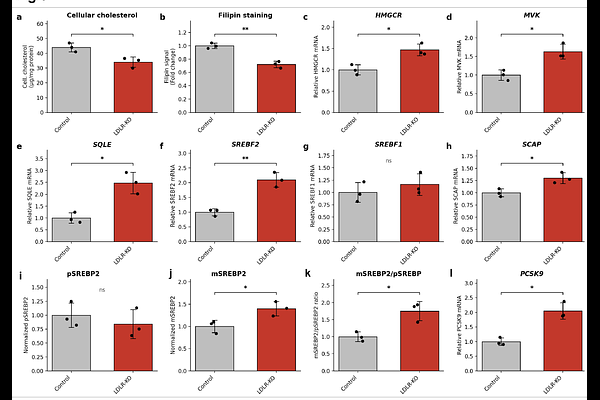
AbstractIonizable lipid nanoparticles (LNPs) are widely used for delivery of CRISPR/Cas9 payloads to hepatocytes, but conventional hepatic uptake is strongly influenced by adsorption of apolipoprotein E and subsequent low-density lipoprotein receptor (LDLR)-mediated internalization. This dependence may limit specificity and reduce efficacy in LDLR-deficient settings. Here, we designed an aptamer-functionalized LNP platform to enable hepatocyte-selective genome editing through an LDLR-independent route and validated its performance using a genetically defined LDLR-knockout HepG2 model. Ionizable LNPs co-encapsulating Cas9 mRNA and an LDLR-targeting guide RNA were surface-decorated with the hepatocellular carcinoma-targeting TLS11a aptamer using thiol-maleimide chemistry. Comprehensive physicochemical analysis using cryo-electron microscopy, dynamic light scattering, pKa titration, UV and circular dichroism spectroscopy, X-ray photoelectron spectroscopy, and molecular beacon assays confirmed uniform nanoparticles of approximately 105 nm, preserved mRNA integrity, retained endosomal charge-switching behavior with a pKa of approximately 6.3 to 6.5, and maintained correctly folded surface-displayed TLS11a. TLS11a decoration increased Cas9 mRNA delivery to HepG2 cells from 39% to 79% Cy5-positive cells, while reducing uptake in receptor-low control cells, supporting aptamer-associated and cell-preferential delivery. In parallel, CRISPR/Cas9-mediated deletion of LDLR exon 2 generated a validated LDLR-deficient HepG2 line, confirmed at genomic, transcript, and protein levels. LDLR loss reduced LDL binding and uptake by approximately 85%, while transferrin uptake was preserved, indicating selective impairment of LDLR-dependent endocytosis. Cholesterol depletion activated the SCAP-SREBP-2 pathway and induced cholesterol biosynthesis genes. Together, these findings establish a modular aptamer-guided LNP system for targeted genome-editing delivery and a validated LDLR-null hepatocyte model for studying LDLR-dependent biology and disease.