Dendritic varicosities revealed as important micro-tubule organisers in neurons

Dendritic varicosities revealed as important micro-tubule organisers in neurons
Chorro, A.; Vineethakumari, C.; Conduit, P. T.
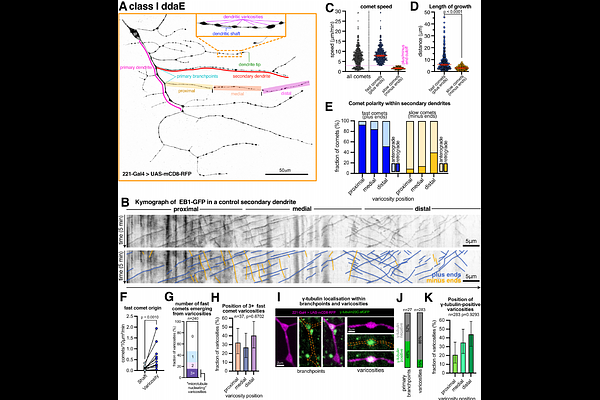
AbstractMicrotubules are polarised polymers that assemble into highly specialised networks in a cell-specific manner. This is controlled in part by microtubule organising centres (MTOCs), which concentrate factors necessary for microtubule nucleation and the organisation of microtubule minus ends. Neurons rely on oppositely polarised microtubule networks, with axons containing mostly plus-end-out microtubules, and dendrites contain many minus-end-out microtubules. How minus-end-out microtubule polarity is established in dendrites remains an important question. Here, we identify a new type of MTOC within the dendrites of Drosophila class I dendritic arborisation neurons, a common model for the neuronal cytoskeleton. We show that membrane swellings distributed intermittently along dendrite shafts, which we term 'dendritic varicosities', contain the principal component of the microtubule nucleating complex and repeatedly generate microtubules whose plus ends grow back towards the soma. Varicosities located specifically in distal regions also contain MTOC proteins implicated in minus end anchoring, and this correlates with the accumulation of minus ends specifically in distal varicosities. Depletion of these MTOC proteins leads to major defects in minus end organisation, with microtubule buckles and loops deforming the neuronal membrane. Thus, dendritic varicosities are an important new type of neuronal MTOC that contribute to the generation and organisation of the minus-end-out microtubule network within dendrites.