AI System Using Unsupervised Learning to Discover Novel Subtypes in Alzheimer's Disease

AI System Using Unsupervised Learning to Discover Novel Subtypes in Alzheimer's Disease
Patel, P.; Patel, R.
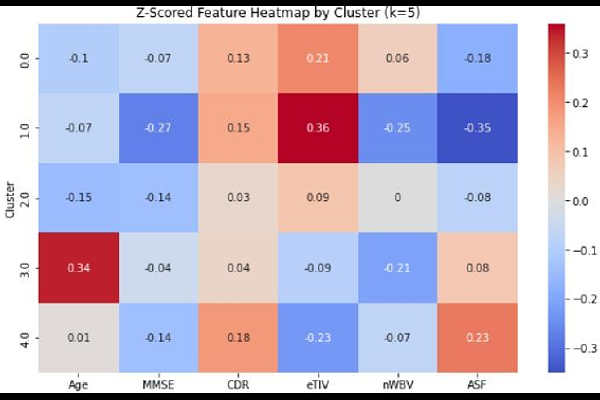
AbstractEarly Alzheimer's disease often evades timely detection because typical diagnostics are based on symptomatic thinking rather than intrinsic neurodegeneration. Here, we use unsupervised machine learning to identify latent Alzheimer's phenotypes from structural MRI-derived volumetric features and neuropsychological scores, without using diagnosis labels or predefined subtype definitions. We analyzed participants (18-96 years) from the OASIS-1 study using intracranial, normalized, global, and regional volumetric MRI features together with MMSE and CDR measurements. After dimensionality reduction with principal component analysis, we identified five stable clusters using K-Means clustering. Here, one cluster exhibited salient cortical atrophy but intact preserved cognitive function, indicative of an independent preclinical subtype. As a reproducibility check, random forest and logistic regression models trained to predict cluster membership achieved >90% cross validated accuracy, indicating that the clusters were consistently separable in the learned feature space. Age and education did not fully explain this structural-functional dissociation, suggesting a subgroup with relative cognitive resilience despite measurable atrophy. Our findings challenge the assumption of a uniform atrophy-cognition relationship and suggest that data-driven phenotyping may reveal clinically relevant subgroups not captured by conventional diagnostic frameworks. Future work will apply validation to longitudinal cohorts, in addition to incorporating multimodal biomarkers.