Drought induced metabolomics of potato leaves highlight metabolic reprogramming and promising biomarkers for smart irrigation advisories

Drought induced metabolomics of potato leaves highlight metabolic reprogramming and promising biomarkers for smart irrigation advisories
Singh, P. D.; Nayak, R.; Dittrich, Y.; Guzinski, R.; Pant, Y.; Masakapalli, S. K.
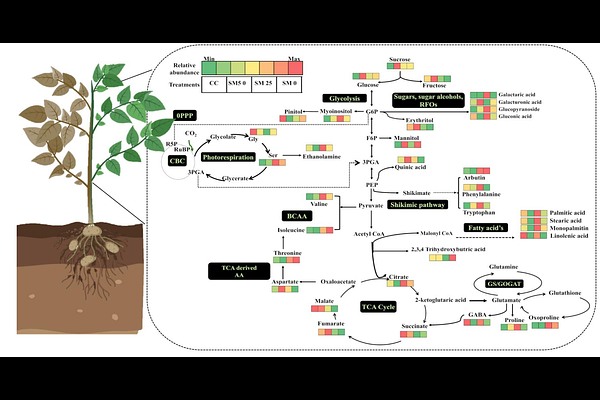
AbstractSmart irrigation management is essential for improving crop resilience under increasing drought frequency driven by climate change. Although satellite-based remote sensing provides valuable tools for monitoring crop water status at large spatial scales, its accuracy is often limited in mountainous and heterogeneous agricultural landscapes. In this study, we investigated drought-induced metabolic responses in potato (Solanum tuberosum L.) to identify biochemical biomarkers that could complement satellite-based irrigation advisories in the mid-Himalayan region of India. A field experiment was conducted using a gradient of soil moisture regimes corresponding to moderate (50% field capacity), critical (25% field capacity), and extreme drought stress (5-8% field capacity). Satellite-derived evapotranspiration-based irrigation advisories were validated against in situ soil moisture measurements, revealing discrepancies attributed to the inability of satellite estimates to capture actual water loss under drought stress conditions, highlighting the need for additional ground-truth biomarkers across heterogeneous field conditions. To capture plant-level physiological responses, untargeted metabolite profiling of potato leaves was performed using gas chromatography-mass spectrometry (GC-MS). Approximately fifty metabolites belonging to amino acids, organic acids, sugars, and sugar alcohols were detected. Multivariate statistical analyses revealed distinct metabolic signatures associated with progressive drought stress. Notably, accumulation of proline, serine, isoleucine, sucrose, fructose, glucose, and polyols such as mannitol and myo-inositol reflected key metabolic reprogramming associated with osmoprotection, redox homeostasis, and energy metabolism under drought conditions. Collectively, this ensemble of stress-responsive metabolites represents a robust panel of drought stress biomarkers. As a proof of concept, proline was validated as a qualitative biomarker of plant water status through a rapid and cost-effective colorimetric biochemical assay, demonstrating its practical applicability for field-level irrigation management. These findings demonstrate that metabolomics-derived biomarkers can provide sensitive plant-level indicators of drought stress that complement satellite-based monitoring systems. The integration of biochemical diagnostics with remote sensing platforms offers a promising approach for improving drought detection and developing low-cost, field-deployable tools for smart irrigation advisories in heterogeneous agricultural landscapes.