Posterior insula oscillations are not modulated by changes in perceived intensity: Evidence from human intracerebral EEG

Posterior insula oscillations are not modulated by changes in perceived intensity: Evidence from human intracerebral EEG
Leu, C.; Boutachkourt, A.; Ferrao Santos, S.; Fierain, A.; Joris, V.; Finet, P.; Liberati, G.
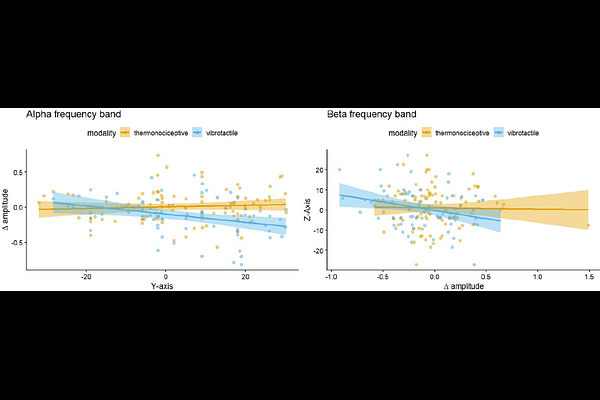
AbstractThe human insular cortex is involved in a multitude of processes essential for survival, but its precise role in pain perception remains debated. While it has been shown that ongoing oscillatory activity in the posterior insula is preferentially modulated by thermonociceptive input, it is unclear whether these modulations are functionally related to changes in pain perception. To assess this link, neural responses to sustained periodic thermonociceptive and non-nociceptive vibrotactile stimulation delivered at a frequency of 0.2 Hz were measured using intracerebral electrode contacts located in the anterior (n=63) and posterior (n=37) insular cortices of 10 patients undergoing presurgical evaluation for focal epilepsy. An arithmetic task was employed concomitant to the stimulation, aiming to reduce participant 's perceived intensity while leaving the physical stimulation parameters unchanged. A frequency-tagging analysis approach was used to assess the modulation of the ongoing neural oscillations. As expected, the perception of the stimulation was significantly reduced during the arithmetic task to a similar extent in both modalities. Yet, no congruent reduction in the frequency-tagged oscillatory responses was found in the posterior insula during distraction, for either of the modalities. On the contrary, during distraction, vibrotactile stimulation elicited larger responses in the anterior insula. These findings suggest that top-down modulation via distraction differentially affects anterior insula responses to innocuous vibrotactile input, while thermonociceptive processing appears to involve additional neural systems during distraction that are not equivalently engaged by vibrotactile stimulation.