Topographic structure and function of locus coeruleus norepinephrine neurons

Topographic structure and function of locus coeruleus norepinephrine neurons
Su, Z.; Kosillo, P.; Jung, K.; Chen, S.; Summers, M. T.; Piet, A.; Hou, H.; Hagihara, K. M.; Friedmann, D.; Ho-Shing, O.; Becker, M. I.; Chartrand, T.; Grotz, P.; Hilton-VanOsdall, E.; Lee, M.; Javeri, R.; Tuggle, S. L.; Ouellette, N.; Myers, H.; Laiton, C.; Wulf, K.; Rohde, J.; Buccino, A. P.; Arshadi, C.; Wang, D.; Seshamani, S.; Vasquez, S.; Eng, C. M.; Ollerenshaw, D. R.; Dee, N.; Casper, T.; Ho, W.; Jungert, M.; Jordan, A.; Phillips, E.; Chakka, A. B.; Nasirova, K.; Blake, K.; McCutcheon, A.; Koch, M.; Vergara, M. C.; Smith, K. A.; Jarsky, T.; Lusk, N.; Rue, M. C. P.; Chen, X.; Siegle, J.
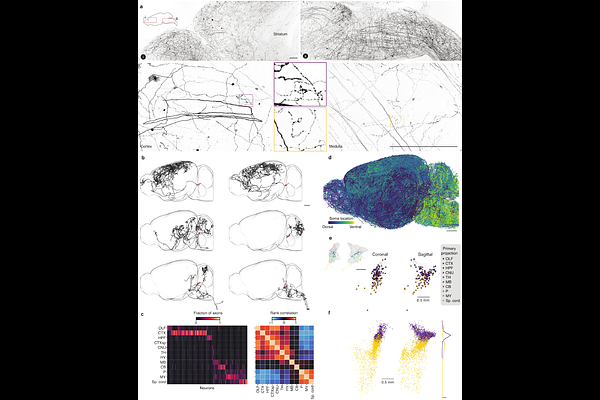
AbstractNorepinephrine (NE) is released throughout most of the central nervous system by neurons in the locus coeruleus (LC). We found a relationship between the morphologies, gene expression, and activity of LC-NE neurons in mice. Axonal projections of individual neurons were extensive but largely confined to subsets of brain regions. Axonal projections and graded gene expression correlated with locations of cell bodies in LC. In a behavioral task requiring ongoing learning from actions, neurons in dorsal LC projecting to the cerebral cortex were excited when mice made a different choice from the previous one and by reward prediction errors, a signal driving learning. Background activity of neurons in ventral LC was higher when mice ignored stimuli indicating potential reward availability. These observations reveal a topographically organized structure and function of a neurotransmitter system and show that it contains learning signals for flexible behavior.