Programming Biomolecular Interactions with All-Atom Generative Model

Programming Biomolecular Interactions with All-Atom Generative Model
Kong, X.; Chen, J.; Zhang, Z.; Li, G.; Zhu, Q.; Wei, L.; Li, M.; Shi, Y.; Dai, W.; Zhang, Z.; Tan, W.; Jiao, R.; Wang, X.; Zheng, J.; Yu, Z.; Wu, Q.; Guo, Z.; Zhang, L.; Li, W.; Huang, Q.; Zhu, T.; Wang, X.; Huang, W.; She, Y.; Zhang, J.; Liu, Y.; Liu, K.; Ma, J.
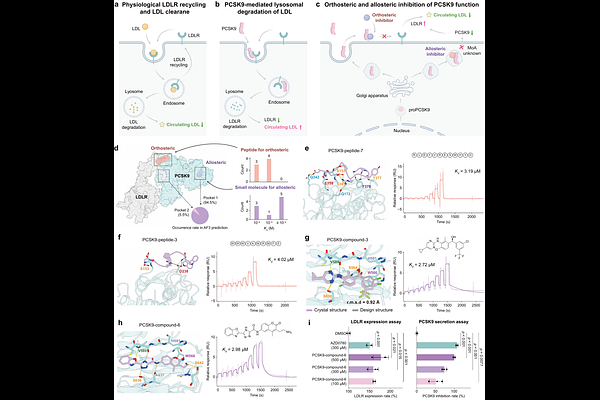
AbstractBiomolecular interactions lie at the core of cellular life, spanning diverse molecular modalities from small molecules to nucleic acids and proteins. Nevertheless, design strategies remain separated despite shared physicochemical principles of molecular recognition. Here we present AnewOmni, a unified generative framework trained on more than 5 million biomolecular complexes, that enables transferable molecular design across molecular scales by assembling chemically meaningful building blocks at atomic resolution. We further introduce programmable graph prompts to support user-defined chemical, topological, and geometric steering during generation, exploring hybrid and unconventional chemistries beyond canonical structures. We demonstrate that transferable learning of interaction patterns and physical constraints across molecular modalities is possible, via an atom-to-block latent space capturing both atomic details and structural priors. The framework successfully designed small molecules, peptides, and nanobodies targeting the challenging KRAS G12D switch II pocket, as well as orthosteric peptides and allosteric small-molecule inhibitors for PCSK9 in the absence of known binding site, achieving 23%-75% success with only low-throughput validation, bypassing modality-specific high-throughput screening. AnewOmni is the first to succeed in functional molecular design across all scales, from small chemical entities to large biologics, and represents a stepstone towards general molecular reasoning engines, advocating a generative foundation model for biomolecular interactions to enter regimes where data and human intuition remain limited.