The metabolome and proteome of stem cell-derived human primordial germ cells: a multi-omics approach

The metabolome and proteome of stem cell-derived human primordial germ cells: a multi-omics approach
Vaz Santos, M.; Schomakers, B. V.; Llobet Ayala, M.; Jamali, T.; van Weeghel, M.; van Pelt, A. M. M.; Mulder, C. L.; Hamer, G.
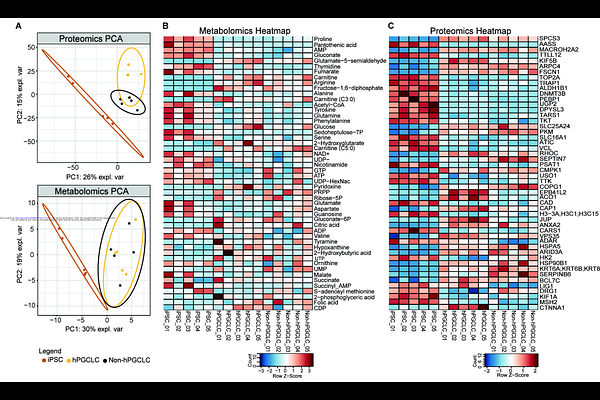
AbstractPrimordial germ cells (PGCs) are the population of cells that, in the human embryo, specify day 12 post-fertilization, and form the precursor cells for the future egg or sperm cells. Although in vitro differentiation of PGCs from human stem cells has been achieved, these primordial germ cell-like cells (hPGCLCs) fail to further mature. The reason for this is unclear. Previous studies in mice revealed that several specific metabolic changes occur during the maturation of these cells, which are essential for their developmental progress. However, very little is known about the metabolic profile of human primordial germ cells. In the severe scarcity of human PGCs, hPGCLCs serve as a research model to study PGC formation. To investigate this, we differentiated hPGCLCs using induced-pluripotent stem cells and performed a mass spectrometry analysis to establish their metabolome and proteome. These cells revealed distinct metabolic profile, with changes particularly at the proteome level. This included a shift between canonical and non-canonical citric acid cycle in hPGCLC, downregulation of late-stage glycolysis and reduction of nucleotide de novo synthesis. By providing an integrative map of these metabolic networks, we aim to provide insight on the influence of metabolism on human PGC development that could help improve methods for in vitro differentiation and maturation hPGCLCs.