Highly sensitive enzyme- and amplification-free, quantitative DNA detection using YVO4:Eu luminescent nanoparticle probes

Highly sensitive enzyme- and amplification-free, quantitative DNA detection using YVO4:Eu luminescent nanoparticle probes
Kuhner, R.; Cardone, C.; Vieira Perrella, R.; Mohammedi, R.; Gacoin, T.; Lestini, R.; Bouzigues, C. I.; Alexandrou, A.
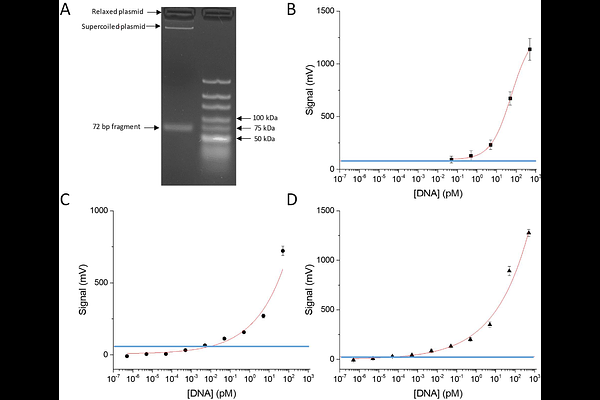
AbstractThe sensitive detection of nucleic acids is crucial for the accurate diagnosis of infections. In this context, amplification-based methods, such as the quantitative Polymerase Chain Reaction (qPCR) are the gold standard for ultrasensitive DNA or RNA detection and quantification. However, despite its widespread use in developed countries during the COVID-19 pandemic, qPCR remains a costly tool, difficult to implement into low-infrastructure locations. Efforts for the development of alternative tools have yielded high sensitivity approaches but sensitivity is typically reached at the expense of complexity. We here report the development of a simple, sensitive, amplification-, and enzyme-free nucleic acid detection technique using YVO4:Eu luminescent nanoparticles. We established an optimized interaction scheme to efficiently reveal target DNA fragments with nanoparticles. By exploiting the extremely strong absorption of the vanadate matrix in the UV to excite the nanoparticles inducing the characteristic Eu3+ emission at 617 nm via energy transfer, we achieved a highly sensitive (down to 500 particles/mm2; 17,000 particles/well) read-out in standard microplates using a home-made optical reader with light-emitting diode (LED), 275-nm excitation. We reached a 50-aM (30,000 copies/mL) sensitivity for the detection of the 72-base DNA fragment of the SARS-CoV-2 n1 gene. Our new quantitative analytical method detects nucleic acids without amplification with performances close to standard PCR (10,000 copies/mL), and could be the basis for a transportable alternative for the diagnosis of infectious diseases.