miRNova: A Next-Generation Platform for Ultra-Precise and Highly Specific MicroRNA Quantification Integrating a Tailored Stem Loop RT-qPCR and a Robust Analytical Framework

miRNova: A Next-Generation Platform for Ultra-Precise and Highly Specific MicroRNA Quantification Integrating a Tailored Stem Loop RT-qPCR and a Robust Analytical Framework
VAN, T. N. N.; Van Der Hofstadt, M.; Houot-Cernettig, J.; Thibal, C.; Nguyen, H. S.; Marcelin, C.; Ouedraogo, A.; Champigneux, P.; Molina, L.; Kahli, M.; Molina, F.
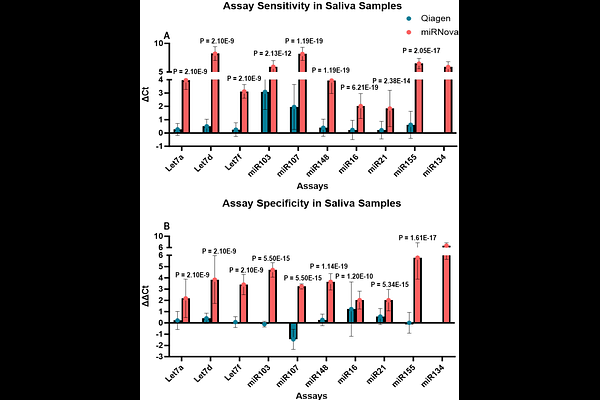
AbstractMicroRNAs (miRNAs) are ultra-short RNA molecules characterized by high sequence homology, frequent post-transcriptional modifications, and typically low abundance, particularly in circulating biofluids. These inherent biological features present substantial technical challenges for RT-qPCR based quantification. Consequently, the development of miRNA RT-qPCR assays has required architectural adaptations at the reverse transcription (RT) stage to generate extended cDNA templates, thereby enabling effective downstream quantitative PCR amplification. One widely adopted approach involves the enzymatic addition of a poly(A) tail to the 3' end of miRNAs, followed by poly(T)-primed universal reverse transcription, which has gained broad acceptance due to its perceived sensitivity and simplified workflow. However, independent experimental evidence indicates that this architecture does not consistently provide the level of specificity required for reliable single-nucleotide (SN) discrimination, particularly when quantifying low-abundance circulating miRNA targets, as demonstrated in our previous study. An alternative strategy relies on miRNA-specific reverse transcription using stem-loop priming has been equally well accepted. When generically generated, this approach offers certain improved specificity, but its performance in resolving single-nucleotide differences remains limited. In this article, we employed precision engineering to maximize specificity for both reverse transcription and qPCR steps. By tailoring both primer design and reaction architecture to the specific sequence features of each miRNA, we enable robust single nucleotide discrimination among these ultra-short targets. Prototype of ten different miRNova assays quantifying miRNAs whose sequences are differed in various configurations were tested on synthetic miRNA targets and small RNAs extracted from different celllines. For miRNova assay validation, saliva samples were elite rugby players submitted to small RNA extraction, then RT-qPCR. Spike-in of synthetic targets was applied for each quantification point to characterized the sensitivity, specificity and accuracy of the assays. Comparative analysis was performed between miRNova and two commercially available kits on the same sample set. The obtained results show a superior performance of miRNova assays allowing for sensitive and accurate quantification of miRNAs in saliva samples. Altogether, this results in modular, reproducible assays optimized for low-abundance miRNA detection in challenging biofluids, including saliva, positioning the platform beyond existing sensitivity-focused solutions toward true diagnostic-grade specificity.