APOE4 disrupts the central dogma by arresting neuronal proteome dynamics

APOE4 disrupts the central dogma by arresting neuronal proteome dynamics
Krogsaeter, E. K.; McKetney, J.; Lishi Li, L.; Liu, I.; Richards, A. L.; Subramanyam, V.; Yin, K.; Gordon, M.; Belio Mairal, P.; Stevenson, E. J.; Qian, H.; Huang, Y.; Goodarzi, H.; Krogan, N. J.; Swaney, D. L.
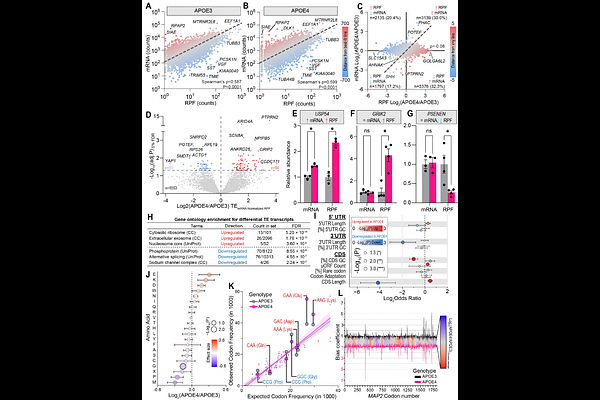
AbstractApolipoprotein E4 (APOE4) is the strongest genetic risk factor for late-onset Alzheimer's disease and promotes neuronal dysfunction through incompletely understood mechanisms. Here, we integrated transcriptomic, translatomic, and proteomic profiling of isogenic APOE3 and APOE4 human iPSC-derived neurons and found that APOE4 fundamentally impairs neuronal proteome renewal. Although transcriptional changes were modest, APOE4 disrupted ribosome occupancy, altered translational dynamics, and uncoupled protein abundance from transcript levels. Proteome-wide turnover measurements revealed a global extension of protein half-lives and widespread accumulation of long-lived proteins. Functional proteomic analyses demonstrated concurrent lysosomal and proteasomal impairments associated with reduced proteasome activity and increased association of APOE with neuronal proteasomes. Longitudinal proteomics further showed that protein accumulation emerges during neuronal maturation and precedes a senescence-like cellular stress state. Together, these findings identify impaired proteome renewal as a central mechanism underlying neuronal vulnerability to APOE4 and establish defective proteostasis as an early pathogenic event in Alzheimer's disease.