Energy and time trade-offs explain everyday human reaching movements

Energy and time trade-offs explain everyday human reaching movements
Wong, J. D.; Herspiegel, W. J.; Kuo, A. D.
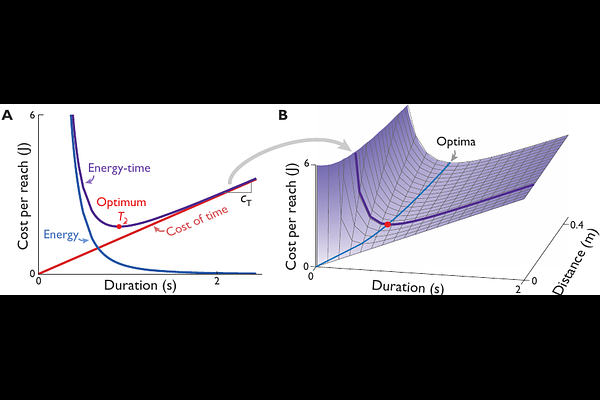
AbstractHumans reach for everyday objects such as pens and cups with stereotypically smooth, relaxed movements, explained in part by optimality. Maximizing accuracy can explain the smoothness and minimizing effort the relaxed timing. But these aspects combined do not optimize the whole, nor do they explain why people vary their timing depending on context, or reach smoothly even when accuracy is not demanded. These realities either challenge the notion of optimality or demand its redefinition. Here we propose that everyday reaching is predicted more generally by minimizing energy expenditure plus a weighted cost of time, adjustable for individual and context. A model of this Energy-Time objective simultaneously predicts human speed trajectories, durations, and peak speeds, without needing separate theories for each. The time valuation is identifiable from a single observation of one\'s time to reach a fixed distance, which then independently predicts how they reach any other distance. This single context-specific parameter can similarly predict reaches with low accuracy or speed demand unexplained by previous theories. The energy term is physiologically measurable and explains that smoothness and slowness are economical. The competing time cost explains how everyday movements can be modulated about an individualistic preference. Energy and time exert systematic influence on the speeds and durations of everyday movements.