E. coli extracellular matrix: a tunable composite with hierarchical structure

E. coli extracellular matrix: a tunable composite with hierarchical structure
Siri, M.; Mangiarotti, A.; Seewald, A.; Rosenthal, N.; Amini, S.; Raguin, E.; Fratzl, P.; Bidan, C. M.
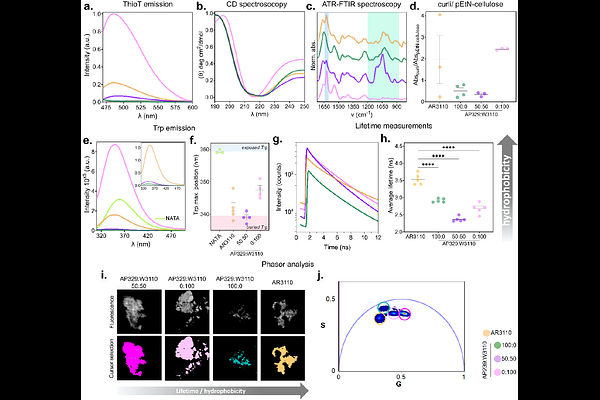
AbstractEscherichia coli (E. coli) biofilms consist of bacteria, an extracellular matrix (ECM) mainly made of curli amyloid fibers, phosphoethanolamine-modified cellulose (pEtN-cellulose), and water. While curli amyloid fibers contribute to biofilm rigidity, pEtN-cellulose contributes to their cohesion. This work explores the interplay between these fibers, and how their interaction influence biofilm structure and mechanical properties. We performed a multiscale analysis on E. coli biofilms grown using strains producing curli and pEtN-cellulose, and only curli and only pEtN-cellulose in co-seeded ratios. Micro-indentation experiments, confocal microscopy, and cryo-FIBSEM 3D imaging revealed a composite-like behavior of the biofilm, where its mechanical properties depend on ECM composition and organization. Spectroscopic analysis of the extracted fibers showed that their biophysical properties are influenced by their pEtN-cellulose to curli ratio and assembly. We propose that pEtN-cellulose swelling is contrained by its interactions with rigid curli fibers. The reference E. coli strain maximizes this effect by assembling a curli/pEtN-cellulose hybrid material at the sub-micron scale, where its composition, interactions, and architecture can explain biofilm emergent properties. This knowledge on microbial ECM assembly opens new avenues for engineering living materials, especially for the use of bacterial biofilms as a source of bio-sourced materials.