Hypothetical lytic transglycosylase SleB is important for cell fitness in Zymomonas mobilis

Hypothetical lytic transglycosylase SleB is important for cell fitness in Zymomonas mobilis
Fuchino, K.; Daniel, R.; Astraios, C.; Vollmer, W.
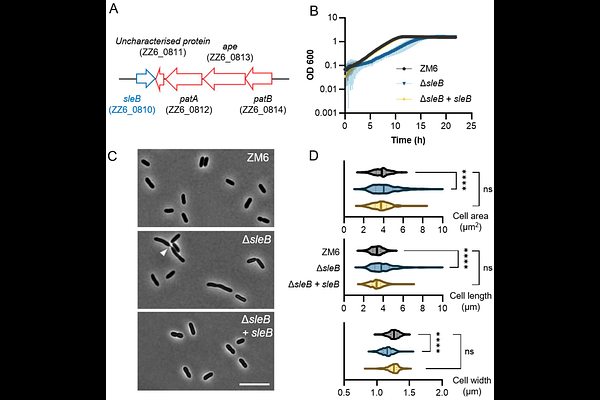
AbstractBacterial peptidoglycan (PG) undergoes a variety of chemical modifications. O-acetylation at the C6 hydroxyl group of N-acetylmuramic acid is a widespread PG-modification found across diverse bacterial phyla. It contributes to virulence in pathogenic bacteria because the O-acetyl group reduces the activity of the PG-degrading host defense enzyme, lysozyme. Beyond its role in host defense evasion, recent studies suggest that PG O-acetylation also regulates the activity of endogenous lytic transglycosylase (LT) autolysins. The ethanologenic alpha-proteobacterium Zymomonas mobilis O-acetylates its PG, which is associated with tolerance to environmental stresses, including salt. To better understand how PG O-acetylation contributes to stress tolerance, we investigated the predicted lytic transglycosylase SleB. Intriguingly, the sleB gene is located adjacent to the pat operon, which encodes the proteins responsible for PG O-acetylation. We showed that loss of SleB caused impaired growth and morphology, and a significant reduction of crosslinks in the PG of Z. mobilis. Furthermore, the sleB mutant was sensitive to environmental stress resembling the sensitivity of the patA mutant. Collectively, our findings unravelled an important role of SleB in PG remodelling and stress resilience.