Small ORF16 modulates the Mtr complex activity in Methanosarcina mazei Goe1 depending on the molecular hydrogen availability

Small ORF16 modulates the Mtr complex activity in Methanosarcina mazei Goe1 depending on the molecular hydrogen availability
Habenicht, T.; Hastedt, B.; Cassidy, L.; Kiessling, C.; Tholey, A.; Schuller, J. M.; Schmitz, R. A.
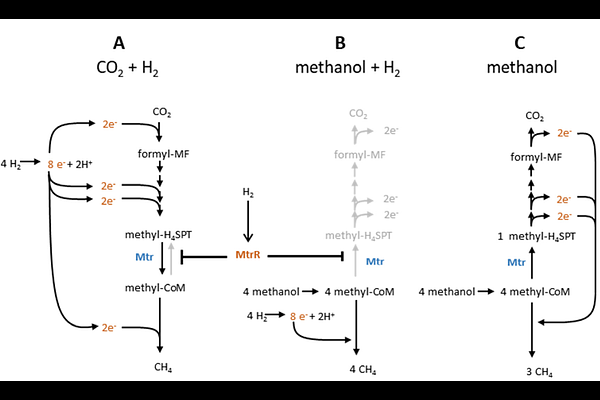
AbstractSmall open reading frame (small ORF)-encoded proteins, with less than 100 amino acids in length, have attracted increasing attention over the past decade after being largely overlooked due to limitations in classical bioinformatics and biochemical methodologies. For the mesophilic archaeal model system Methanosarcina mazei Goe1, a high number of previously unannotated small ORFs have been identified through ribosome profiling combined with LC-MS/MS analysis. However, the physiological role of the majority of the respective small proteins remains unknown. Here, we report on the functional characterization of the small ORF16 encoded small protein MtrR (49 amino acids). We demonstrate that MtrR is forming oligomers localized at the cytoplasmic membrane. There, it interacts with the tetrahydrosarcinapterin S-methyltransferase (Mtr), a key membrane-bound complex of the energy metabolism, and impacts its activity. In vitro interaction and in vivo copurification assays showed MtrR interaction with the Mtr-complex, which was further validated by microscale thermophoresis analysis demonstrating a specific strong interaction with the MtrA subunit. Analyzing growth under varying molecular hydrogen (H2) availability demonstrated that the small ORF16 deletion mutant showed significantly impaired growth in the presence of H2, independent of the carbon source. Consequently, we propose that MtrR fine-tunes the activity of the Mtr-complex in response to fluctuating H2 availabilities, allowing to adapt the energy metabolism to changing environmental H2 conditions.