Quantum synchronization and chimera states in a programmable quantum many-body system

Quantum synchronization and chimera states in a programmable quantum many-body system
Kazuya Shinjo, Kazuhiro Seki, Seiji Yunoki
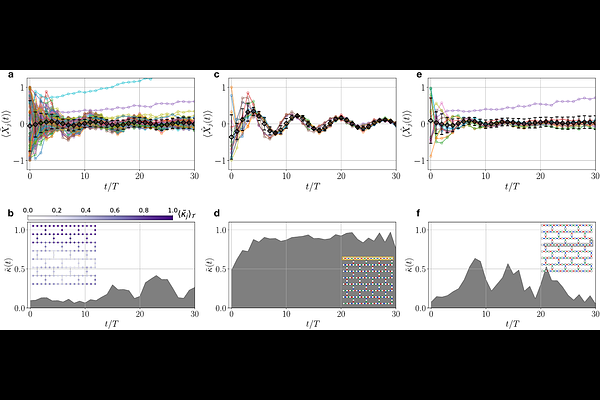
AbstractSynchronization is a hallmark of collective behavior in classical nonlinear systems, yet its realization as a robust many-body phenomenon in coherent quantum systems remains largely unexplored. Here we demonstrate symmetry-protected quantum synchronization and a quantum chimera state in coherent Floquet dynamics on programmable superconducting quantum processors. By implementing stroboscopic evolution of a two-dimensional Heisenberg model on IBM heavy-hex devices, we observe that initially phase-randomized spins spontaneously self-organize into coherent lattice-wide oscillations. On 28 qubits, synchronization persists even for strongly randomized initial states and is stabilized by SU(2) symmetry, as confirmed by explicit symmetry breaking. Scaling up to 156 qubits reveals a qualitatively distinct regime. For weak initial randomness, global synchronization extends across the device. For strong randomness, the system fails to synchronize globally, yet subsets of qubits exhibit robust local phase coherence under homogeneous unitary dynamics. This coexistence of globally desynchronized and locally synchronized regions constitutes a quantum analogue of a classical chimera state. Statevector and matrix-product-state simulations reproduce both the symmetry-protected synchronization and the chimera coexistence, demonstrating that these phenomena arise from the intrinsic Floquet many-body dynamics. Our results establish symmetry-protected synchronization and quantum chimera states as experimentally accessible nonequilibrium dynamical phases in programable many-body quantum systems.