Nascent transcripts of LL2R tandem repeat nucleate locus-specific RNP condensates recruiting splicing factors

Nascent transcripts of LL2R tandem repeat nucleate locus-specific RNP condensates recruiting splicing factors
Krasikova, A.; Zlotina, A.; Kulikova, T.; Schubert, V.; Fedorov, A.
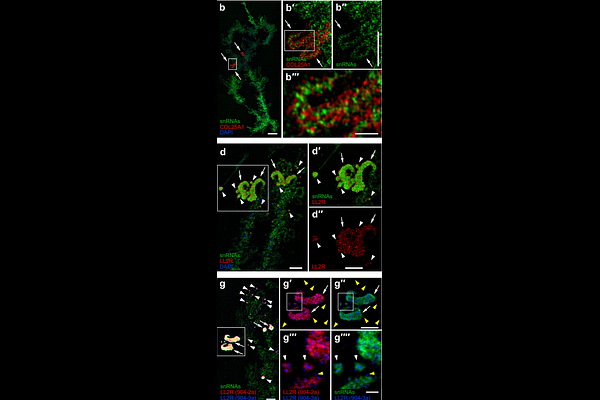
AbstractSpatial organization of the cell nucleus is increasingly understood to be governed by non-coding architectural RNAs that seed the formation of biomolecular condensates. However, the genomic origins and mechanistic principles by which specific architectural RNAs orchestrate ribonucleoprotein (RNP) compartments remain poorly defined. Here, we characterised a novel non-coding architectural RNA that nucleates the formation of a locus-associated membraneless nuclear compartment. Using a combination of T2T genomic, transcriptomic, and high-resolution mapping on giant lampbrush chromosomes, we identified an array of non-coding LL2R tandem repeats on the long arm of chicken chromosome 2. The LL2R tandem repeat array is slowly transcribed by a convoy of RNA polymerases II as a single transcription unit from a retrotransposon promoter. With the use of scanning electron and super-resolution microscopy for detailed analysis, we demonstrate that nascent LL2R repeat transcripts are retained at the site of their transcription and recruit multiple sets of core splicing factors, including TMG-capped snRNAs, core snRNP proteins, and serine/arginine-rich proteins SRRM2 and SC35 that contain intrinsically disordered regions, thus seeding nuclear domain formation. At the same time, the RNP-matrix of the LL2R repeat transcription unit lacks hnRNP L, hnRNP K, and SFPQ, widely distributed along normal transcription loops that bear nascent gene transcripts. In contrast to pre-mRNAs, strand-specific LL2R tandem repeat-containing RNA contains more than threefold excess of predicted donor splice sites compared to acceptor splice sites and is depleted in polyadenylation signals. We suggest that stalling of elongating RNA polymerases at LL2R transcription units and delay in 3' end cleavage may be caused by a deficiency of co-transcriptional splicing of nascent LL2R repeat transcripts. LL2R repeat-containing RNA also forms non-diffusible RNP-aggregates enriched by splicing factors that could serve as a site of post-transcriptional splicing. Our findings reveal how tandem repeat-derived RNAs drive the assembly of oocyte nuclear condensates, providing a functional template for understanding the formation of closely related nuclear speckles and nuclear stress bodies across eukaryotes.