VesSynth: Tubes Are All You Need for Robust Cross-Scale Cross-Modal 3D Vessel Segmentation

VesSynth: Tubes Are All You Need for Robust Cross-Scale Cross-Modal 3D Vessel Segmentation
Mauri, C.; Mckenzie, A.; Analoro, C.; Yeon, E.; Coviello, R.; Mora, J.; Chollet, E.; Deden Binder, L.; Mahar, A.; Lin, S.; Benlahcen, M.; Ream, A.; Jama, A.; Garcia, I.; Tran, N.; Onta, P.; Wood, S.; Willis, A.; Mahmood, A.; Sinoballa, G.; Malki, A.; Tran, K.; Malireddy, V.; Onumajuru, N.; Lakshmanan, S.; Hercules Landaverde, K.; Sidow, R.; Wood, D.; Nguyen, B.; Hernandez, J.; Bernier, M.; Hunter, J.; Malki, A.; Tum, A.; Chavez, V.; Shahu, Z.; Vasi, I.; Visser, A.; Ghaouta, Z.; Bond, F.; Vigneshwaran, R.; Kirkpatrick, E.; Avalos Barbosa, M.; Rauh, K.; Herisse, R.; Garcia Pallares, E.; Zeng, X.
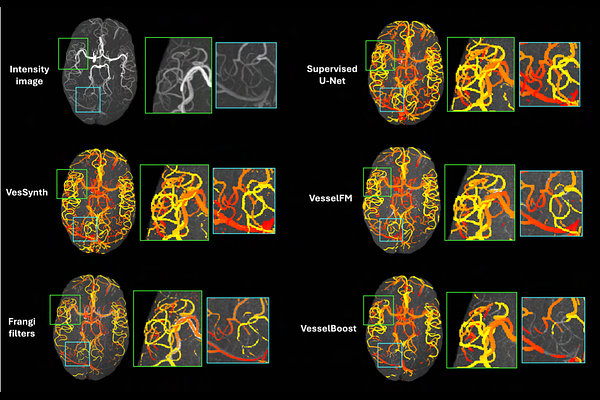
AbstractThe cerebral vasculature is central to brain function, with alterations linked to numerous cerebrovascular and neurological disorders. Yet, no single imaging modality can capture the entire cerebral vascular network in humans. Instead, an array of techniques are sensitized to different spatial scales, while trading off resolution for coverage. Magnetic Resonance Imaging (MRI) typically resolves only large pial vessels, while high-resolution microscopy allows micrometer-scale vessels to be mapped over limited spatial extents. These techniques must therefore be combined to obtain a complete mapping of the cerebral angioarchitecture, which underscores the need for automatic, cross-modal vessel segmentation. Here, we introduce VesSynth, a flexible vessel segmentation framework that achieves state-of-the-art accuracy across multiple modalities and spatial resolutions (MR, optical and X-ray imaging), despite being trained entirely on synthetic data. By enabling consistent vascular mapping across scales, this framework paves the way to comprehensive investigation of cerebrovascular organization and its role in health and disease.