Cryo-EM structures of Alpha-Synuclein(31-100) amyloid fibrils reveal disease-like structural motifs without reproducing the Parkinson's Disease polymorph

Cryo-EM structures of Alpha-Synuclein(31-100) amyloid fibrils reveal disease-like structural motifs without reproducing the Parkinson's Disease polymorph
Biedermann, K.; Rhyner, D.; Frey, L.; Riek, R.; Greenwald, J.
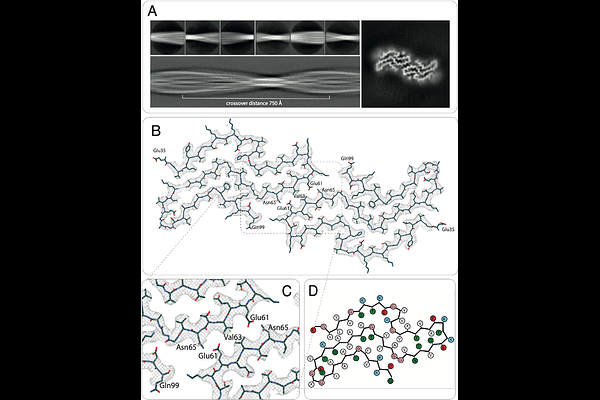
AbstractThe structural diversity of alpha-synuclein amyloid fibrils is closely linked to the pathogenesis of Parkinson's disease and related synucleinopathies. However, reproducing disease-associated fibril conformations from recombinant full-length protein in vitro has remained challenging. Inspired by successful truncation strategies developed for the Tau protein, we investigated whether removing the disordered terminal regions ("fuzzy coat") of alpha-synuclein could bias fibril assembly toward disease-relevant folds. We designed a truncated construct comprising residues 31-100, corresponding to the structured core of patient-derived Parkinson's disease fibrils, and systematically screened aggregation conditions across a broad range of pH values and ionic environments. Cryo-electron microscopy revealed four previously undescribed fibril structures, including new subtypes of the established type 1 and type 3 polymorphs and a novel fibril fold, termed type 10, which reproducibly formed under acidic conditions. Type 10 was observed as two distinct dimeric assemblies (10A and 10B) that share a common protofilament fold but differ in their inter-filament interfaces. Structural comparison with the patient-derived Parkinson's disease polymorph revealed local similarities, including conserved beta-strand organization and loop conformations within the fibril core, but remains structurally distinct overall. Our results demonstrate that rational construct design combined with systematic environmental screening reshapes the alpha-synuclein polymorphic landscape and promotes structural motifs characteristic of disease-associated fibrils.