SNPstar: A Web Server Linking Allelic Variation to Protein Structure and Function in Arabidopsis thaliana

SNPstar: A Web Server Linking Allelic Variation to Protein Structure and Function in Arabidopsis thaliana
Schmidt, B.; Pilgram, L.; Babben, S.; Trenner, J.; Gago-Zachert, S.; Pezzini, F.; Tueting, C.; Behrens, S.-E.; Tahir, M.; Grau, J.; Kuenze, G.; Kastritis, P. L.; Grosse, I.; Quint, M.
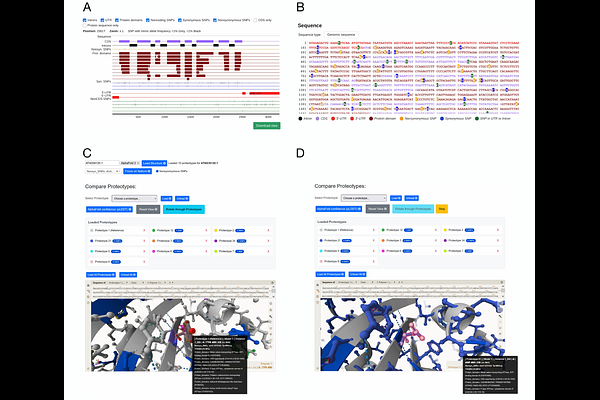
AbstractUnderstanding how natural genetic variants affect protein structure and function is central to plant biology. The 1001 Genomes Project has catalogued millions of single nucleotide polymorphisms (SNPs) across more than a thousand Arabidopsis thaliana accessions, offering an unprecedented opportunity to relate sequence variation to three-dimensional protein structure and population context. Yet, realizing it requires tools that integrate these scales in one accessible framework. Here we present SNPstar, a web server that links allelic variation in A. thaliana to AlphaFold3-predicted structures through a gene-centric, interactive interface. SNPstar annotates each variant with descriptive features, thermodynamic stability estimates, protein domain context, and genome-wide association results, and computes haplotypes and proteotypes that group accessions by shared DNA or protein sequence. Researchers can characterize variants, visualize their structural context, map their geographic distribution, and prioritize accessions for experimental validation without local computational infrastructure. We demonstrate SNPstar with two case studies. The first recapitulates known loss-of-function variation in the cadmium transporter HMA3, validating that SNPstar prioritizes functionally consequential alleles. The second uses SNPstar-defined proteotypes to identify an N-terminal SNP combination in ARGONAUTE 2 that distinguishes accessions differing in in vitro siRNA-directed target cleavage, linking protein-coding variation to a measurable molecular phenotype. SNPstar thus helps translate natural variation into mechanistic insight.