Null geodesic defocusing in dynamical black-hole-to-white-hole transitions

Null geodesic defocusing in dynamical black-hole-to-white-hole transitions
Johanna Borissova, Stefano Liberati, Matt Visser
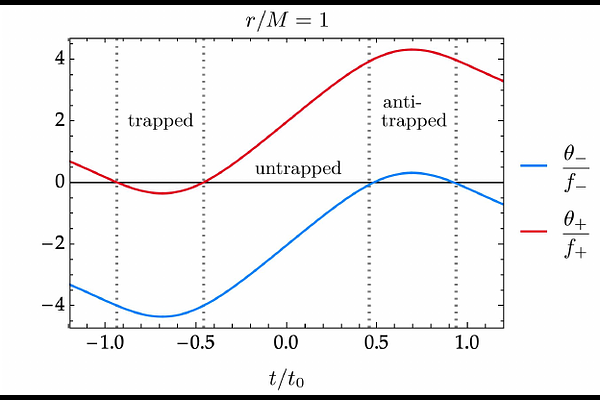
AbstractWe investigate the defocusing of null geodesics in dynamical, non-singular black-hole-to-white-hole transitions. Working at the level of spacetime kinematics, and without assuming any specific gravitational field equations, we show that the contraction and disappearance of a trapped region, as well as the subsequent formation and expansion of an anti-trapped region, necessarily require a violation of the null convergence condition. This conclusion follows directly from the behaviour of the null expansions across the trapping and anti-trapping horizons, and is therefore independent of the microscopic mechanism responsible for singularity resolution. We then illustrate this general argument by constructing a class of explicit bouncing geometries in generalised Painlevé-Gullstrand coordinates, obtained by promoting static regular black holes with de Sitter cores to time-dependent black-hole-to-white-hole transition models. For a Bardeen-type mass function, we show that the required violation of the null convergence condition is localised within the intermediate dynamical phase in which the trapped region evaporates and the anti-trapped region forms. Finally, we argue that the limiting case of an instantaneous black-hole-to-white-hole transition would require an unbounded violation of the null convergence condition, signalling a breakdown of the effective continuum metric description, and the need to appeal to a full quantum-gravitational description.