Detecting Frame Dragging Effect with Next-Generation Spaceborne Clocks in a LEO-DRO Satellite Configuration

Detecting Frame Dragging Effect with Next-Generation Spaceborne Clocks in a LEO-DRO Satellite Configuration
Li-Fang Li, Hanlin Song, Xing Bian, Tong Liu, Shao-Jiang Wang, Song He, Yang Li, Jiaxing Leng, Ziren Luo, Peng Xu, Rong-Gen Cai
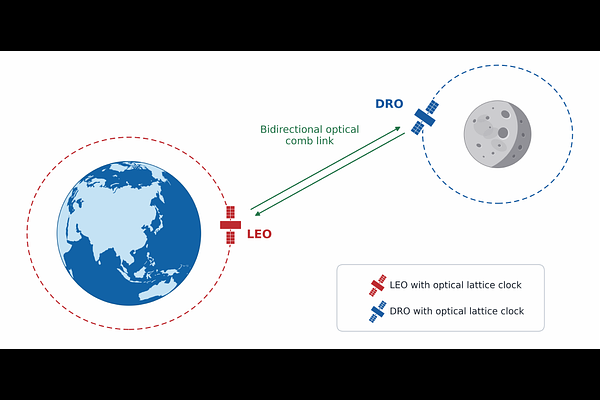
AbstractOur approach employs a satellite constellation comprising one satellite in low Earth orbit (LEO) and one satellite in distant retrograde orbit (DRO). This configuration is designed to enhance the sensitivity to the Earth's rotation-induced frame-dragging signal while providing a stable and gravitationally isolated frequency reference. We derive a complete relativistic formulation for the frequency comparison between LEO and DRO, incorporating the post-Newtonian metric, higher-order Earth multipoles, lunar and solar tidal potentials, and the gravitomagnetic vector potential. The frame-dragging signal is of order $10^{-20}$, a level that is becoming increasingly accessible with next-generation optical clocks. Recent advances in zero-dead-time strontium optical lattice clocks have demonstrated a fractional frequency instability of $2.9\times10^{-19}$ at an averaging time of 20,000~s, with an estimated one-day stability of $2.5\times10^{-19}$. With continued advances in clock stability, achieving fractional-frequency sensitivity at the $10^{-20}$ level appears feasible in the near term, potentially enabling the direct measurement of a frame-dragging signal of the same order. Such a measurement would constrain Earth's gravitomagnetic field, enabling future investigations of gravitomagnetic effects on Einstein clock synchronization.