MaxWave Signal: Rapid, coherent maximum likelihood wavelet reconstruction of transient signals in gravitational wave data

MaxWave Signal: Rapid, coherent maximum likelihood wavelet reconstruction of transient signals in gravitational wave data
Sudhi Mathur, Neil J. Cornish
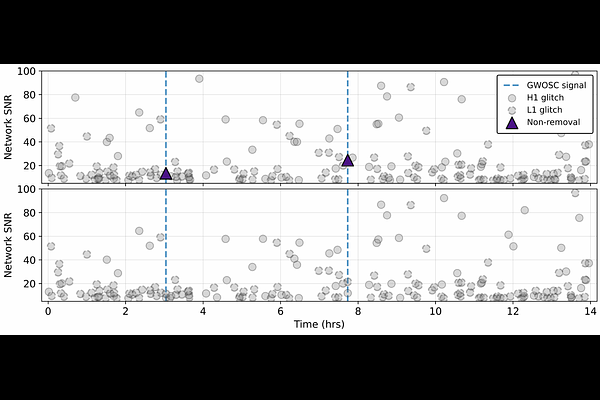
AbstractAdvances in gravitational-wave detector sensitivity have increased the rate of transient signal detections, demanding faster automated analysis. We extend MaxWave, a fast maximum likelihood wavelet reconstruction algorithm, to perform coherent multi-detector signal reconstruction and glitch rejection. We coherently search for a common set of wavelets modeling the signal in all detectors. Multi-detector data are aligned using z-statistic time and phase offsets and amplitude scalings relative to the dominant reconstruction, as well as adaptive noise weightings derived from a geometrically averaged noise spectrum. By aligning and weighting individual detectors, we form a synthetic detector that amplifies non-Gaussian features, down-weights noisy detectors, and preserves Gaussian noise statistics. We extract the coherent signal using this synthetic detector, improving sensitivity to weak events while rejecting coincident glitches that lack consistent phase and amplitude evolution. Our algorithm provides real-time, low-latency, model-independent signal reconstructions, safely denoises gravitational wave data without removing transient signals, and can complement existing burst search and reconstruction frameworks through a fundamentally distinct approach, strengthening detection confidence and improving sensitivity to diverse signal morphologies.