Crowder-specific modulation of hepatitis C virus NS3/4A protease activity and local structural dynamics

Crowder-specific modulation of hepatitis C virus NS3/4A protease activity and local structural dynamics
Lobka, M.; Trylska, J.
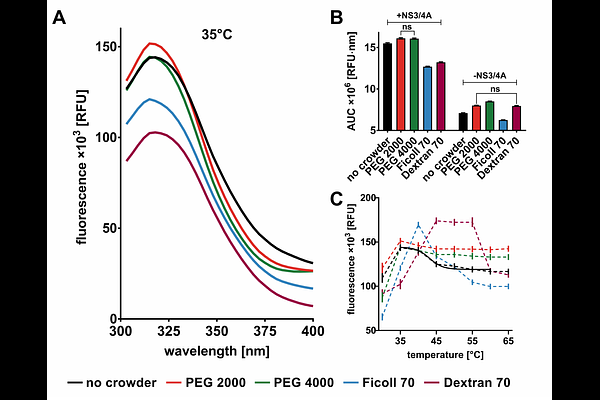
AbstractMacromolecular crowding modulates enzyme behavior in crowder- and protein-specific ways, yet its impact on viral proteases, which are often key therapeutic targets, remains unclear. Here, we investigated the hepatitis C virus NS3/4A protease under increasing concentrations of polyethylene glycols (PEGs), ficoll, dextran, and lysozyme using a fluorescence-based activity assay and intrinsic tryptophan fluorescence. PEGs reduced catalytic activity while leaving substrate binding largely unaffected or moderately enhanced. These effects were accompanied by a moderate tryptophan fluorescence spectral narrowing, consistent with reduced heterogeneity in local conformational environments. In contrast, ficoll enhanced catalytic efficiency despite stronger fluorescence quenching, indicating local structural changes that favored catalysis. Dextran and lysozyme inhibited protease activity through distinct kinetic patterns, likely reflecting differences in their size, shape, and chemical properties. Thermal analysis revealed crowder-specific local structural changes in NS3/4A without global unfolding up to 65{degrees}C, with differences in local stability and flexibility corroborating the observed kinetic effects. These findings demonstrate that macromolecular crowding modulates NS3/4A catalysis through crowder specific effects on local structure.