Electrophysiological properties of mesodiencephalic junction neurons projecting to the inferior olive

Electrophysiological properties of mesodiencephalic junction neurons projecting to the inferior olive
Voerman, S.; Wang, X.; Bosman, L. W. J.; Broersen, R.; De Zeeuw, C. I.
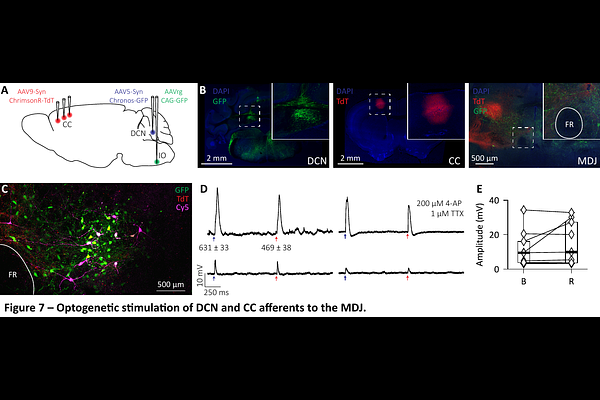
AbstractNeocortex has the largest volume, while cerebellar cortex houses most neurons of the mammalian brain, underscoring paramount functions for interactions between them. Neocortex projects to the cerebellum via both the mossy fibre and climbing fibre system; whereas the mossy fibres find their origin in the pons, the climbing fibres are relayed via the subnuclei of the inferior olive (IO) that receive their cortical input from the mesodiencephalic junction (MDJ). Since climbing fibres regulate cerebellar plasticity in a timing-dependent manner, the MDJ-IO pathway probably contributes to both sensorimotor and cognitive learning. However, the physiological properties of IO-projecting MDJ neurons remain largely unknown. Here, we made targeted whole-cell recordings in acute brain slices of the murine MDJ, separating IO- from non-IO-projecting neurons following retrograde tracing. We show that IO-projecting neurons are spontaneously active and are capable of high frequency-bursts up to 350 Hz during current injections. Action potentials of IO-projecting MDJ neurons depolarize and re-polarize quickly, and hyperpolarizing inputs consistently trigger rebound action potentials upon stimulus offset. Instead, non-IO-projecting neurons in the same MDJ region are hardly spontaneously active with little rebound activation. Even so, IO-projecting MDJ neurons can also transform excitatory and inhibitory inputs into a proportional output, indicating that they can also employ rate coding. Moreover, neocortical inputs to IO-projecting MDJ neurons can directly be integrated with their inputs from the cerebellar nuclei. Our results highlight how neocortical inputs to the MDJ can be transformed into diverse IO firing patterns and thereby contribute to the required specifics of cerebellar learning.