Impact of coalescence signals on the search for continuous gravitational waves with Einstein Telescope

Impact of coalescence signals on the search for continuous gravitational waves with Einstein Telescope
Elena Codazzo, Lorenzo Mirasola, Matteo Di Giovanni, Pia Astone, Sabrina D'Antonio, Cristiano Palomba, Claudia Lazzaro, Andrea Contu, Alessandro Riggio, Andrea Sanna
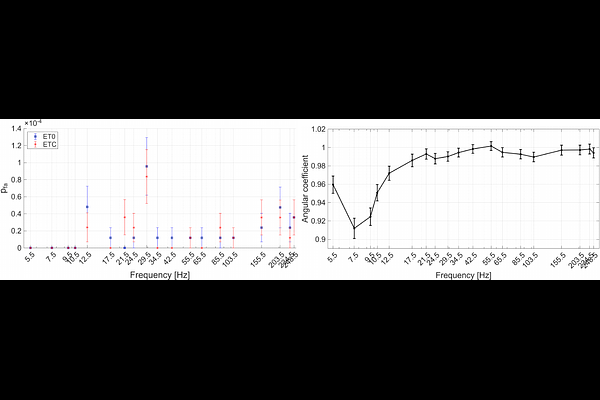
AbstractThe current network of gravitational wave detectors has already revealed hundreds of compact binary coalescences (CBCs), including binary neutron stars, binary black holes, and black hole-neutron star systems. As detector sensitivity improves, the superposition of these signals is expected to form an astrophysical background that becomes increasingly relevant for future observatories. In third generation detectors, such as the Einstein Telescope (ET), this background will be most prominent at low frequencies, potentially affecting the search for continuous gravitational waves (CWs) from spinning neutron stars. In this work, we evaluate the impact of the CBC background on CW detection using the Frequency-Hough pipeline, with a focus on the low-frequency performance in ET sensitivity conditions. Through realistic simulations of the unresolved CBC background, we find that it acts as an additional noise source, most strongly affecting the detection of CW signals around 7 Hz, worsening the FH sensitivity by about 7-10%.