DnaE uses strand displacement synthesis during Okazaki fragment repair

DnaE uses strand displacement synthesis during Okazaki fragment repair
Kendal, A.; Lowder, F. C.; Jeffery, L.; Simmons, L.
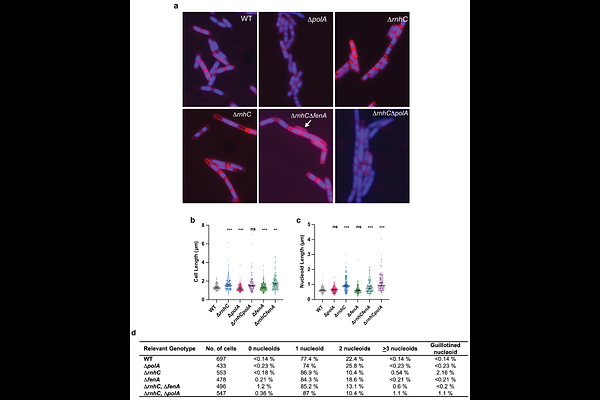
AbstractRNA serves the essential role of priming DNA replication for all organisms. In bacteria, it is estimated that more than 20,000 ribonucleotides accumulate on the lagging strand per round of replication. Despite the importance of RNA primers in initiating DNA synthesis, unresolved primers result in strand breaks and induction of the DNA damage response, leading to genome instability. In bacteria, the prevailing model suggests that DNA polymerase I (Pol I) replaces RNA primers with DNA during lagging strand replication. However, in Bacillus subtilis, we show that {triangleup}polA cells have a near wild-type phenotype, demonstrating that cells lacking Pol I still perform efficient Okazaki fragment repair. To determine how cells compensate for the loss of Pol I, we tested the ability of two major replicative polymerases, DnaE and PolC, to participate in lagging strand replication in vitro. We found that DnaE replicates an Okazaki fragment as efficiently as Pol I using strand displacement synthesis. In contrast, PolC is unable to catalyze strand displacement synthesis, but can facilitate repair when combined with a nuclease or a gapped substrate. Together, our work shows that B. subtilis can use several different mechanisms to replicate the lagging strand, ensuring fidelity within the replication cycle.