Neural correlates of the subjective experience of free-will during value-based risky decisions: a pilot study

Neural correlates of the subjective experience of free-will during value-based risky decisions: a pilot study
Modak, P.; Brown, J. W.
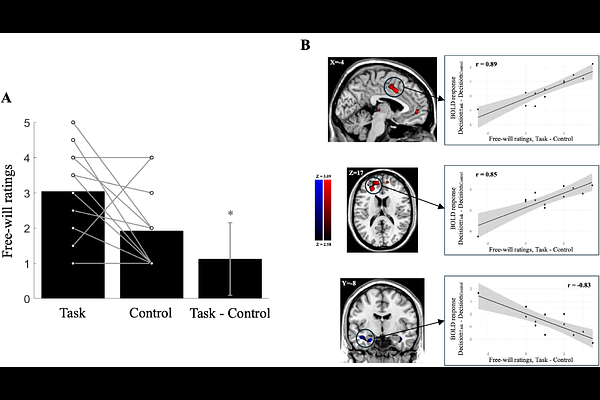
AbstractUnderlying the very notion of choice is the fundamental idea of free-will, which is challenged by decision-neuroscience aiming to explain and predict choices using interactions of neurons. The question of whether any choice is truly a free-choice and born out of free-will has long been a subject of philosophical debate. In this work, we do not take a position on this debate, rather investigating the subjective experience of free-will, whose existence is more universally accepted. We had healthy participants report the level of their experienced free-will while performing value-based risky decision-making task to find the neural and behavioral correlates of this experience. We identified regions in mid-cingulum and middle frontal gyrus showing positive association with self-reported free-will as well as a region in hippocampus and parahippocampal gyrus showing a negative association. The requirement to report the experience of free-will was associated with a higher BOLD signal in striatum during decision-making. Behaviorally, we found a positive trend between RT and free-will. While our sample size is small, these results help forming hypotheses for further studies with larger cohorts and provide a proof-of-concept for the investigations of neural and behavioral mechanisms of the subjective experience of free-will in decision research.