A Broadband Room-Temperature Design for the Einstein Telescope

A Broadband Room-Temperature Design for the Einstein Telescope
Teng Zhang, Amit Singh Ubhi, Huan Yang, Alan V. Cumming, Mark Barton, Angus Bell, Fabio Bergamin, Giacomo Bruno, Katherine L. Dooley, Johannes Eichholz, Mariana Fazio, Aaron Goodwin-Jones, James Hough, Keiko Kokeyama, Haixing Miao, Xingrui Peng, Geraint Pratten, Stuart Reid, Sheila Rowan, Patricia Schmidt, Alberto Vecchio, Giles Hammond, Hartmut Grote, Denis Martynov
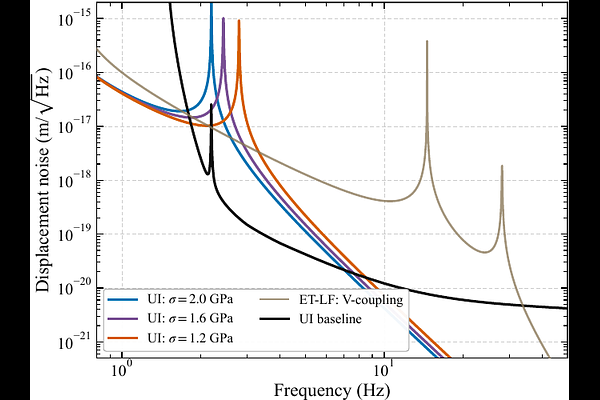
AbstractThe unique underground location of the Einstein Telescope (ET) is expected to substantially suppress seismic and gravity-gradient noise, providing a favorable environment for gravitational-wave detection at low frequencies compared with surface-based observatories. The baseline ET design aims to achieve broadband sensitivity through a xylophone configuration, in which separate cryogenic and room-temperature interferometers are optimised for low- and high-frequency gravitational-wave detection. However, achieving the target low-frequency sensitivity introduces substantial technical complexity caused by vertical suspension thermal noise, vibrations of the cryocooler, and detuned optical configuration. In this paper, we demonstrate an alternative, entirely room-temperature, fully resonant, single-interferometer architecture that addresses these challenges and achieves broadband sensitivity superior to that of the conventional ET xylophone configuration. Using mature fused-silica suspension technology, recent advances in optical coatings, and novel inertial isolation, we show that 4-m-long fused-silica fibres can meet the required suspension thermal-noise performance. We further demonstrate that vibrations, optical rigidity, and quantum back-action noise can be controlled through appropriate design of the interferometer, test mass suspensions, optical seismometers, and quantum states.