Neryl diphosphate-derived monoterpene biosynthesis via a biosynthetic gene cluster in the liverwort Marchantia polymorpha

Neryl diphosphate-derived monoterpene biosynthesis via a biosynthetic gene cluster in the liverwort Marchantia polymorpha
Wei, G.; Kawaguchi, T.; Romani, F.; Flores-Sandoval, E.; Xie, M.; Chen, X.; Koedaka, T.; Iwasaki, K.-i.; Nakanishi, M.; Hemmi, H.; Chen, J.-G.; Bowman, J.; Haseloff, J.; Matsui, K.; Chen, F.
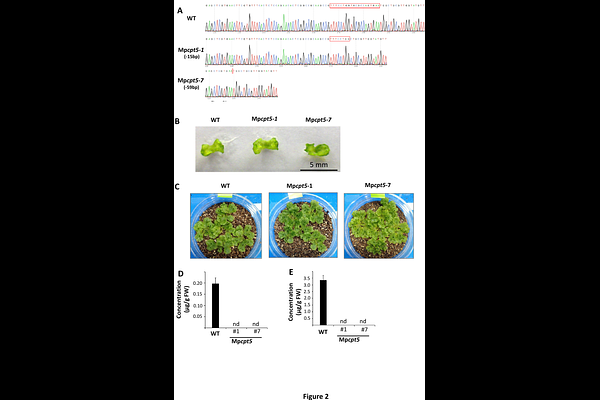
AbstractMonoterpenes (C10) are a large group of specialized metabolites important for plant interactions with the environment. Their biosynthesis is well understood in seed plants, where geranyl diphosphate serves as the canonical substrate, but knowledge of monoterpene biosynthesis outside seed plants remains very limited. Here, we report neryl diphosphate (NPP)-derived monoterpene biosynthesis via a biosynthetic gene cluster in the liverwort Marchantia polymorpha. MpMTPSL2, a microbial-type terpene synthase, converts NPP into -phellandrene and D-limonene in vitro. CRISPR knockout lines showed reduced production of both monoterpenes, providing direct genetic evidence for its in planta function. MpCPT5, a cis-prenyltransferase (CPT) family member identified through co-expression with MpMTPSL2, was confirmed to encode NPP synthase, as its knockout plants abolished -phellandrene and D-limonene production. Subcellular localization analyses in protoplasts and stable transgenic plants demonstrated that both MpCPT5 and MpMTPSL2 localize to plastids, co-localizing across all cell types with markedly stronger signals in non-green plastids of oil-body cells. Consistent with this, expression of both genes under their respective promoters was nearly abolished in oil-body-deficient mutants and strongly upregulated in a gain-of-function line for oil-body formation. MpMTPSL2 and MpCPT5 are physically linked through a shared bidirectional promoter that drives their coexpression specific to oil body cells, forming a unique biosynthetic gene cluster whose coordinated expression is maintained by PRC2-mediated H3K27me3 repression. Phylogenetic analysis implies that NPP synthases in M. polymorpha and in flowering plants evolved independently from their respective long-chain CPT ancestors. These findings provide new insights into the mechanisms and evolution of monoterpene biosynthesis in non-seed plants.