Non-canonical ATR signalling via NBS1 phosphorylation propagates fork slowing from stressed to unperturbed nuclear regions

Non-canonical ATR signalling via NBS1 phosphorylation propagates fork slowing from stressed to unperturbed nuclear regions
Krietsch, J.; Ceppi, I.; Comstock, W. J.; Piquet, S.; Kuster, D.; Vivalda, F.; Aouami, M.; Thoeny, L.; Braunshier, S.; Dibitetto, D.; Sartori, A. A.; Polo, S. E.; Smolka, M. B.; Cejka, P.; Lopes, M.
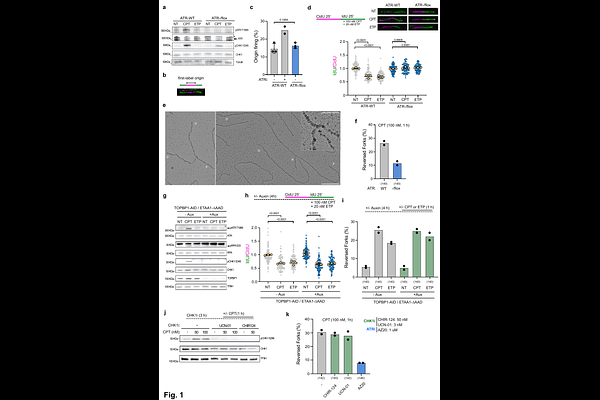
AbstractDNA replication forks frequently encounter obstacles and remodel into four-way junctions to actively slow DNA fork progression. Fork slowing can also spread to undamaged forks via an ATR-dependent mechanism that remained elusive. Here, using mild genotoxic stress, we show that fork slowing and reversal require full ATR activity, but no canonical ATR activators and signalling partners, defining a non-canonical ATR pathway distinct from origin firing control. Phospho-proteomics in S-phase cells under checkpoint-blind replication stress identified a subset of ATR-dependent phospho-sites, such as S343 on NBS1, the regulatory subunit of the MRN complex. This residue is essential to stimulate MRN exonuclease activity in vitro and required in cells for global fork slowing upon mild DNA damage. Ultimately, local UV-C micro-irradiation reveals that ATR-dependent MRN-stimulated resection dampens DNA synthesis at lesions and propagates fork slowing to undamaged chromatin, supporting MRN-mediated ssDNA exposure as a mean to coordinate replication slowdown across the nucleus.