OEP24.1 involved in carbon allocation is a receptor of piecemeal plastid autophagy in Arabidopsis

OEP24.1 involved in carbon allocation is a receptor of piecemeal plastid autophagy in Arabidopsis
Lambret, L.; Le Hir, R.; Luo, J.; Chardon, F.; Marmagne, A.; Masclaux-Daubresse, C.
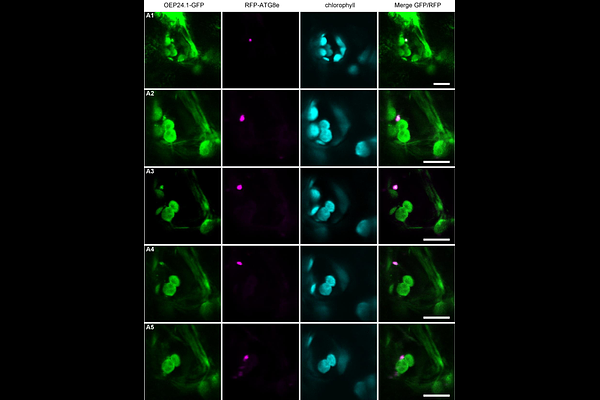
AbstractMacroautophagy is a conserved intracellular catabolic process in eukaryotes that participates in chloroplast degradation, through the selective breakdown of chloroplast components. Selective autophagy of membrane-bound organelles typically requires receptors that bridge organelle membranes and pre-autophagosomal structures. Here we identify OEP24.1 as a new receptor in the selective chloroplast piecemeal autophagy, supporting the degradation of stromal proteins. We found that the {beta}-barrel protein OEP24.1 is located at the outer membrane of plastid envelopes and on bodies budding off plastids into the cytosol and containing stroma proteins. OEP24.1 interacts physically with ATG8 autophagy proteins in a UIM dependent manner. OEP24.1-GFP and RFP-ATG8 colocalize with in mobile autophagosome-like puncta in the cytosol and in autophagic bodies within the vacuole. Delivery of OEP24.1 to vacuole lumen is dependent on active autophagy. OEP24.1 controls carbon allocation at the whole plant level, carbon concentrations in flowering stems and xylem composition. These phenotypes can be explained by the role of OEP24.1 in metabolite diffusion across the chloroplast envelope, and by its involvement in the facilitation of chloroplast quality control through piecemeal autophagy.