Telomerase RNA regulates the epigenome primed for human lineage commitment

Telomerase RNA regulates the epigenome primed for human lineage commitment
Li, J.; Su, P.; Gao, M.; Liu, C.; Li, N.; Feng, G.; Yu, Y.; Chen, Z.; Yin, G.; Ye, X.; Lu, J.; Jin, Z.; Zhu, Z.; Liu, H.; Wang, H.; Liu, L.
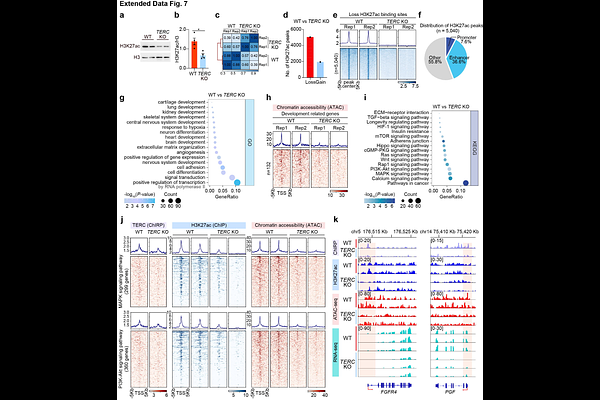
AbstractTelomerase RNA (TERC) is known as the essential template for telomere elongation. Here, we report an unexpected role for TERC in regulating chromatin accessibility, which is primed for determining the cell fate of human embryonic stem cells (hESCs). TERC-deficient hESCs retain critical markers for pluripotency but fail to undergo lineage differentiation as shown by standard in vivo teratoma formation as well as in vitro differentiation assays, which is consistent with repressed transcription during differentiation into the three germ lineages. Notably, transient re-introduction of TERC into TERC-deficient hESCs rescued lineage differentiation capacity without restoring telomere length. TERC binds to the promoters and enhancers of developmental genes marked by H3K27ac to maintain an open chromatin state. Loss of TERC reduces H3K27ac deposition and decreases chromatin accessibility through the remodelling of three-dimensional genome organization, including TAD boundary insulation and compartment switching. Collectively, our findings reveal that TERC is a chromatin-associated noncoding RNA that regulates the epigenomic architecture that governs cell fate for lineage commitment during development.