Human Lymph Node Cellular Senescence Atlas Reveals Age-Dependent Alteration in Germinal Center B Cell Function and Niches

Human Lymph Node Cellular Senescence Atlas Reveals Age-Dependent Alteration in Germinal Center B Cell Function and Niches
Farzad, N.; Enninful, A.; Lu, Y.; Parisi, F.; Fung, A.; Kwon, Y.; Li, Y.; Labrosse, M.; Yang, M.; Strino, F.; Chen, L.; Yang, J.; Zhong, M.; Gao, F.; Tao, B.; Cunningham, J.; Bai, Z.; Li, H.; Wang, F.; Stankewich, M.; Kim, D.; Dong, M.; Bramer, L. M.; Bhat, M. R.; Loe, E.; Craft, J.; Pasa-Tolic, L.; Halene, S.; Shi, L.; Kluger, Y.; Xu, M. L.; Fan, R.
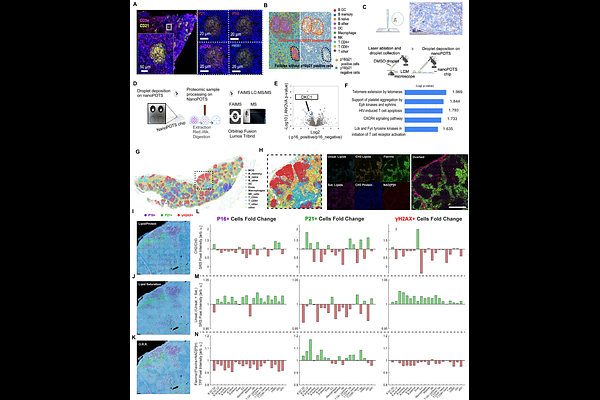
AbstractImmunosenescence, the age-associated decline in immune function, is a key feature of human aging. In human lymphoid organs, however, the specific immune cell populations that acquire senescence-associated phenotypes during aging and how they influence the surrounding tissue microenvironment remain poorly understood. A spatially resolved map of these senescence-associated immune states in human lymphoid tissues could help clarify their relationship with aging and their potential contributions to the progressive decline of immune function. Here, we integrated single-cell and spatial multi-omics to systematically characterize age-related senescence in human lymph nodes (LNs). Single-cell transcriptomics of lymphoid tissues from donors aged 18 to 100 years old identified 34 immune and stromal cell types and revealed age-associated upregulation of senescence signatures in specific populations. Spatial proteomic profiling of 99 LN sections from 51 donors (18-86 years) using high-plex immunofluorescence (~20 million cells) mapped senescence markers (p16, p21, HMGB1, yH2AX) at single-cell resolution, revealing diverse senescent-like cell types ("senotypes") and a stepwise shift from extrafollicular to germinal center (GC) localization with age. Notably, we observed focal clonal-like senescence in GC B cells in older donor LNs. Spatial transcriptomics, epigenomics, and metabolic imaging of selected samples further elucidate the multi-omics signatures and underlying mechanisms of functional impairment, metabolic remodeling, and distinct regulatory programs in senescent-like GC B cells. This study presents a comprehensive spatial atlas of senescence-associated immune states in human lymph nodes, revealing cell-type-specific and spatial heterogeneity that may contribute to immunosenescence and the decline of immune function during aging.