Strong-Field Gravitational-Wave Lensing from Ray-Traced Arrival-Time Surfaces

Strong-Field Gravitational-Wave Lensing from Ray-Traced Arrival-Time Surfaces
Luka Vujeva, João S. Santos, Brian C. Seymour
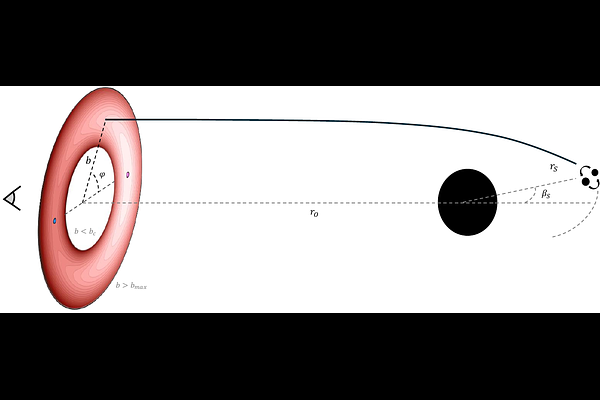
AbstractThe diffraction integral formalism has been greatly successful in describing gravitational wave lensing effects in scenarios where the wavelength of the signal is comparable to the characteristic length scale of the lens, known as the wave optics regime. However, the assumptions required to construct its integrand break down as the source approaches the strong gravity region of a black hole lens. In particular, we are interested in the lensed signal from a binary (the source) near a massive black hole (the lens). We present a new formalism for obtaining low frequency corrections to sources being lensed in the strong field regime of gravity by leveraging the fact that null geodesics obey the Hamilton--Jacobi equations. In doing so, we are able to construct a time delay surface without relying on the thin lens approximation, and solve the diffraction integral for the resulting surface directly. For a stationary source at $10M$, deep in the strong field regime, when comparing the results with a relativistic wave scattering model, we find $6.5\%$ and $0.3\%$ agreement in the peak amplification and first diffractive fringe, respectively. Furthermore, we find a $< 1\%$ agreement with the amplitude of the point mass lens with a source at $10^4 M$ in the weak field, but noticeable dephasing between the peaks of the amplification function at higher frequencies. This work allows for clean interpolation between otherwise separate regimes, valid for sources from $\sim 6M \to \infty$. It provides a transparent, physically motivated framework for computing beyond-geometric optics lensing effects in the strong field regime.