The IFT-A complex plays a major role in the assembly of anterograde intraflagellar transport trains

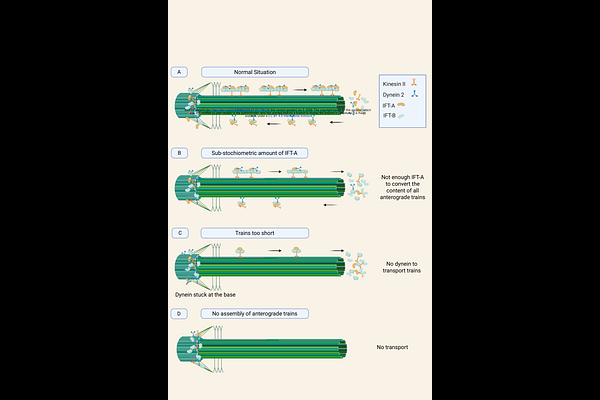
The IFT-A complex plays a major role in the assembly of anterograde intraflagellar transport trains
Mallet, A.; Blisnick, T.; Bertiaux, E.; Fort, C.; Majrouh, M.; Trepout, S.; Bastin, P.
AbstractCilia are assembled by intraflagellar transport (IFT), which relies on two protein complexes: IFT-A and IFT-B. It is generally assumed that IFT-B and IFT-A are critical for anterograde and retrograde transport, respectively. However, full deletion of IFT-A genes in several organisms suggests a possible contribution to anterograde transport. In many species, cilia collapse when IFT is altered, hindering functional studies. Here, we investigated the role of IFT-A in the protist Trypanosoma brucei, where IFT is not required for cilium maintenance. Following the inducible knockdown of IFT88 (an IFT-B member) or IFT140 (an IFT-A member), we monitored the fate of several IFT proteins in preassembled cilia using live imaging and evaluated the consequences on train formation by volumetric electron microscopy. Surprisingly, both IFT88 and IFT140 turned out to be essential for anterograde train assembly. Their depletion initially led to the formation of shorter trains and subsequently to an inhibition of train injection. We propose a model to reconcile the diverging phenotypes reported in the literature.