Bacterial Hsp70 DnaK transiently samples the proteome to rapidly capture stress-induced misfolding

Bacterial Hsp70 DnaK transiently samples the proteome to rapidly capture stress-induced misfolding
Pajari, A.; Redchuk, T.; Mäkelä, J.
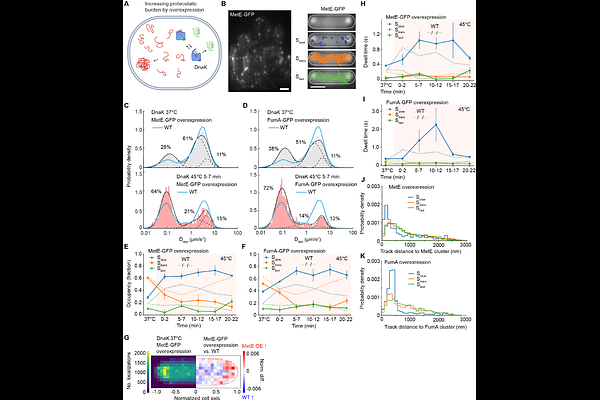
AbstractProtein-quality-control systems are essential for cells to maintain protein homeostasis during both steady-state growth and acute stress. Yet, how individual chaperone molecules dynamically reorganize in living cells as protein unfolding and aggregation rates change, remains poorly understood. Here, we use super-resolution imaging and single-molecule tracking to define the in vivo dynamics of the bacterial heat shock protein 70 (Hsp70) DnaK in live Escherichia coli. We found that majority of DnaK molecules actively engage with the proteome already at the optimal growth temperature, while heat stress induces the accumulation of a distinct slow-moving DnaK population with increased dwell times. These interactions occupy different intracellular regions, suggesting spatially separated chaperone activities. Finally, DnaK folding activity becomes burdened in cells lacking co-chaperones, such as IbpAB, HtpG or DnaJ. Overall, our findings reveal transient proteome interactions as a main chaperone mode of action, enabling DnaK to sense and mitigate proteotoxic stress in living cells.