Pre-clinical models of idiopathic scoliosis implicate sex-specific roles for complement activity in modulating spinal curve severity

Pre-clinical models of idiopathic scoliosis implicate sex-specific roles for complement activity in modulating spinal curve severity
Erfani, V.; Ciruna, B.
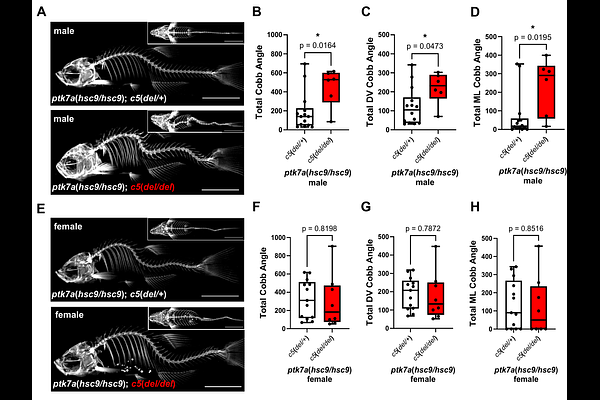
AbstractIdiopathic scoliosis (IS) is the most common spinal deformity and disproportionately affects adolescent females with severe disease. Although its etiology remains unclear, increasing evidence implicates inflammatory pathways in spinal curve progression. The complement cascade, a central component of innate immunity, has been linked to IS, but its functional role has not been directly tested. Here, we use zebrafish IS models to investigate the contribution of complement signaling to scoliosis pathogenesis. We develop novel genetic tools to upregulate or downregulate the core complement components C3 and C5, enabling direct assessment of their roles in modulating spinal curvature. Applying these tools to the sspo IS model, we show that exogenous upregulation of c3 significantly increases scoliosis severity in females. In ptk7a IS models, we demonstrate that loss of c5 markedly exacerbates spinal curve severity specifically in males. Together, our findings identify complement signaling as a sex-dependent modifier of scoliosis severity in zebrafish and provide functional evidence linking innate immune activity to the progression of spinal deformity. These results offer a potential mechanistic explanation for the sex bias observed in human IS and highlight the complement cascade as a candidate target for therapeutic intervention.