Learned landmark associations support online visual control under degraded visibility

Learned landmark associations support online visual control under degraded visibility
Roessling, G.; Fajen, B.
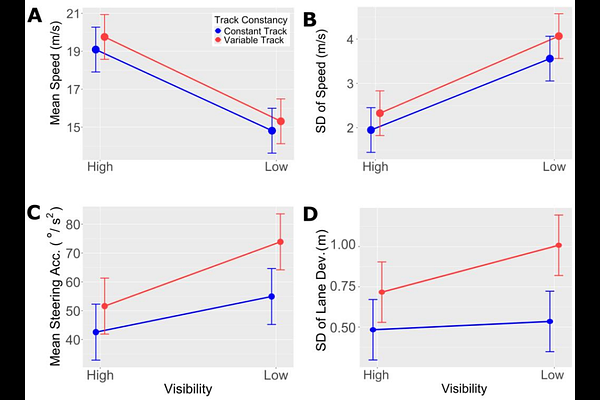
AbstractHumans and other animals often act in environments that are at least partly familiar, where aspects of the spatial layout are known. Although such knowledge is known to support navigation and spatial cognition, its role in the online control of action remains unclear. We investigated whether drivers use knowledge of road layout to guide steering in high and low visibility and, if so, the form of such knowledge. In two simulated driving experiments (total N = 90), participants repeatedly drove winding roads containing segments with and without fog. Drivers who repeatedly experienced the same road exhibited more stable steering and lane positioning than drivers encountering novel roads, but only when visibility was reduced. These advantages were accompanied by superior performance on post-tests assessing knowledge of road geometry. We next examined the form of such knowledge by dissociating global knowledge of road layout from local associations between landmarks and road segments. Disrupting landmark-road segment associations produced the largest impairment in steering performance. The benefits of prior experience were largely preserved when road-segment order was scrambled but landmark associations remained intact. These findings show that spatial knowledge can support moment-to-moment steering control when visibility is reduced. Rather than relying on a globally coherent representation of the environment, drivers use local associations between landmarks and upcoming road geometry to anticipate future demands. More broadly, the results elucidate how familiarity with environmental structure contributes to the control of action when visual information is degraded, revealing a close interplay between spatial knowledge and visual control.