Dfm1 promotes Ste24-dependent translocon quality control

Dfm1 promotes Ste24-dependent translocon quality control
Avaala, J. A.; Owutey, S. L.; Bailey, C. G.; Alexander, K. L.; Alexander, K. E.; Palackel, M.; Beckett, T. S.; Procuniar, K. A.; Richards, K. A.; Woodruff, K. A.; Lehman, K. M.; Paxton, K. M.; Bommineni, S.; Akoto, E.; Turk, S. M.; Miller, J. M.; Barton, H. J.; Fults, E. S.; Tomko, R. J.; Rubenstein, E. M.
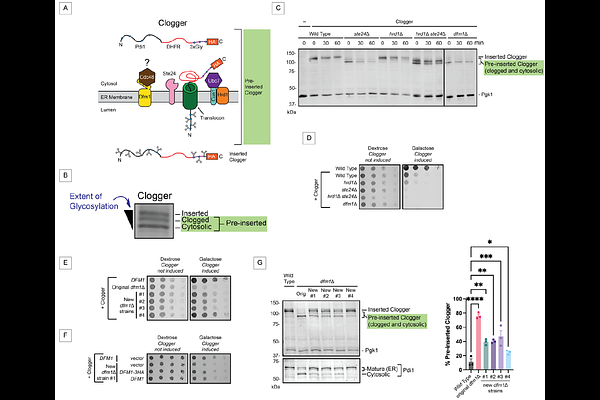
AbstractProteins stalled during endoplasmic reticulum translocation clog Sec61 channels and require translocon quality control (TQC) mechanisms for clearance. Genetic screens implicated the derlin Dfm1 in TQC; however, its mechanistic role remained unclear. Using engineered and disease-relevant translocon-clogging substrates in Saccharomyces cerevisiae, we show Dfm1 functions in the Ste24-dependent branch of TQC, but not Hrd1- or Ltn1-dependent pathways. Loss of DFM1 increased accumulation and toxicity of translocon-clogging proteins. Increased dosage of wild type or catalytically inactive Hrd1 or Ste24 rescued toxicity, supporting a non-enzymatic buffering function for these factors in TQC. These findings identify Dfm1 as a key TQC factor whose critical role in clearing clogged translocons can be suppressed in multiple ways. Our results suggest enhancing TQC may protect cells from proteotoxic stress caused by disease-relevant translocon-clogging substrates, with potential implications for pancreatic {beta}-cell dysfunction in diabetes. Significance StatementO_LICells rely on translocon quality control (TQC) to clear proteins that clog the Sec61 translocon, but how the derlin Dfm1 contributes to this process has remained unclear. C_LIO_LIWe demonstrate that Dfm1 functions specifically in the Ste24-dependent TQC pathway and show that increased levels of the TQC factors Hrd1 or Ste24 rescues Dfm1 deficiency even without catalytic activity, revealing an unexpected non-enzymatic buffering function. C_LIO_LIThis work defines Dfm1s mechanistic role in TQC, provides new insight into how cells preserve endoplasmic reticulum function during translocation stress, and establishes a framework for investigating conserved pathways that protect against diseases associated with translocon clogging. C_LI