Dissociable roles of dopamine D1 and nicotinic receptors in nicotine-motivated responding and impulsive action in a Go/No-Go self-administration task

Dissociable roles of dopamine D1 and nicotinic receptors in nicotine-motivated responding and impulsive action in a Go/No-Go self-administration task
Chellian, R. k.; Huisman, G.; Caglayan, L.; Bruijnzeel, A.
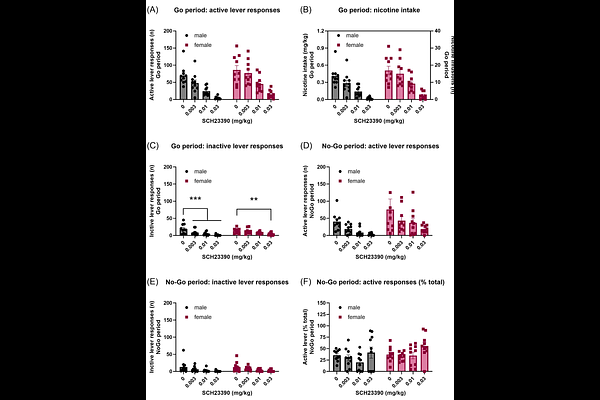
AbstractCigarette smoking remains one of the most important preventable causes of premature death worldwide. However, the mechanisms sustaining nicotine dependence and relapse are incompletely understood, particularly the role of impulsive action in persistent tobacco use. Dopamine D1 and nicotinic acetylcholine receptors both regulate nicotine-related behavior, but whether they contribute differently to nicotine-motivated responding and nicotine-induced impulsive action is unclear. The present study examined the effects of D1 receptor blockade and stimulation in male and female rats trained to self-administer nicotine intravenously in a Go/No-Go task. Nicotine was available during Go periods but not during No-Go periods, and impulsive action was measured as the percentage of active lever responses during No-Go periods. The D1 receptor antagonist SCH23390 reduced nicotine intake and active lever responding during Go periods and affected the percentage of active lever responses during No-Go periods. However, SCH23390 also reduced inactive lever responding, so its effect on impulsive action could not be separated from a general reduction in operant output. In contrast, the D1 receptor agonist A77636 reduced nicotine intake and Go-period responding without affecting No-Go responding, indicating that D1 receptor stimulation reduced nicotine-motivated responding without altering impulsive action. Rats showed greater No-Go responding during nicotine self-administration than during saline self-administration, indicating that nicotine increased impulsive action rather than general operant responding. The non-selective nicotinic antagonist mecamylamine reduced nicotine-motivated responding and decreased No-Go responding, indicating reduced impulsive action. These findings suggest that nicotinic acetylcholine receptor signaling plays a major role in nicotine-induced impulsive action, whereas D1 receptor signaling contributes more clearly to nicotine-motivated responding. D1 receptor agonism may reduce nicotine-motivated behavior without affecting nicotine-induced impulsive action.