Cryptic diversity in Astyanax (Characiformes: Acestrorhamphidae) from the Magdalena basin, Colombia: Insights from molecular and morphometric evidence

Cryptic diversity in Astyanax (Characiformes: Acestrorhamphidae) from the Magdalena basin, Colombia: Insights from molecular and morphometric evidence
Marquez, E. J.; Garcia-Castro, K. L.; Alvarez, D. R.; DoNascimiento, C.
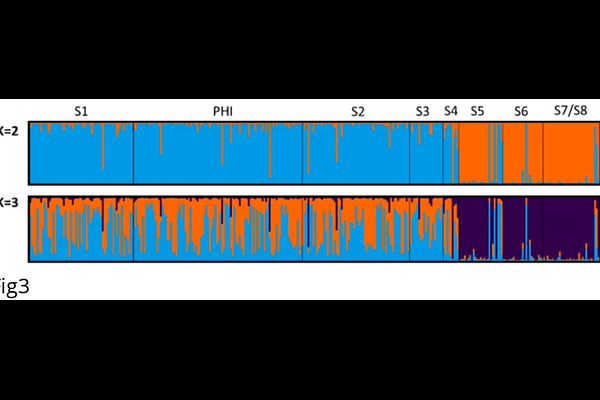
AbstractAstyanax Baird & Girard, 1854 is a widely distributed and species-rich genus of Acestrorhamphidae, whose abundant populations in Neotropical basins play a crucial ecological role at the trophic level. Taxonomic uncertainties persist within the genus, as seen in Astyanax sp. (formerly designated as A. fasciatus) from the Magdalena basin in Colombia. Concerns about its genetic status are heightened due to ecological threats posed by hydroelectric dams, from habitat loss to river connectivity. We isolated and characterized 17 microsatellite loci to assess the population genetics of this species in a broad sample from the middle and lower sections of the Cauca River, now interrupted by the Ituango dam. Furthermore, a multidisciplinary approach integrating phylogenetic analyses of mitochondrial (COI) and nuclear (rag2) markers with geometric morphometric analyses was employed to evaluate potential cryptic diversity within Astyanax sp. Microsatellites revealed two genetic groups in the studied area, strongly supported as distinct lineages by phylogenetic analyses. Unexpectedly, one of these lineages of Astyanax sp. was recovered in an unresolved clade with samples of A. microlepis and allopatric samples of A. viejita from the Maracaibo Lake basin. Each genetic group showed high genetic diversity, but also evidence of recent bottleneck events and significant-high values of inbreeding. Morphometric analyses provided evidence of significant phenotypic differentiation among A. microlepis, Astyanax sp. 1 (Asp1), and Astyanax sp. 2 (Asp2). Morphological patterns ranged from the robust profile of A. microlepis to the streamlined shape of Astyanax sp. 2 (Asp2), with Astyanax sp. 1 (Asp1) displaying intermediate traits and localized differences in head length and fin placement. Statistical support from permutation tests and a high overall classification accuracy (95.65%) underscore the existence of distinct morphospecies, suggesting that phenotypic differentiation is well-established, despite the complex evolutionary history of the group. This study suggests the presence of cryptic diversity within Astyanax sp. and provides valuable genetic information for the conservation and management of their populations in the Magdalena basin.