Structural and functional heterogeneity in cardiac RyR signalling nanodomains revealed with quantitative single molecule mapping toolkit

Structural and functional heterogeneity in cardiac RyR signalling nanodomains revealed with quantitative single molecule mapping toolkit
Köhler, R.; Hurley, M. E.; White, E.; Jayasinghe, I.
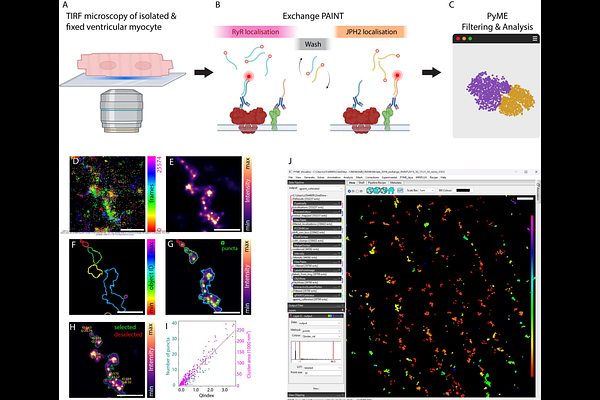
AbstractThe nanoscale organisation of ryanodine receptor type-2 (RyR2) channels and junctophilin-2 (JPH2) shapes cardiac calcium release, but how this relationship is remodelled in right ventricular failure remains unclear. We developed an integrated analysis pipeline building on multiplexed DNA-PAINT data to quantify RyR2 and JPH2 abundance, stoichiometry of co-clustering, and spatial organisation within individual subsarcolemmal calcium release nanodomains. Applied to cardiomyocytes from control rats with pulmonary hypertension-induced right ventricular failure, the approach revealed reduced co-localisation between RyR2 and JPH2 within peripheral junctions and greater variability in their co-clustering stoichiometry across the cell. A subvariogram analysis further showed divergent remodelling of JPH2 expression patterns across subcellular length scales, indicating that disease alters both local molecular composition and cell-wide spatial heterogeneity. Experimentally derived RyR2/JPH2 maps were then used to model as two-dimensional templates for stochastic reaction diffusion of calcium release. Simulations of spontaneous calcium waves from failing cells showed up to 25% wave propagation. Maps from failing cells supported faster transverse and longitudinal calcium dependent release, consistent with the emergence, that support the likelihood of heterogeneous modulation and coupling of RyR resulting from the RyR redistribution and heterogeneous JPH2 expression in the failing cell. Together, these findings identify spatially heterogeneous RyR2-JPH2 remodelling as a potential substrate for dysregulated calcium signalling in right ventricular failure and establish a transferable toolkit for linking molecular nanostructure to cellular function.