Near-equiprobable binary branching decisions underlie filament patterning in the moss Physcomitrium patens

Near-equiprobable binary branching decisions underlie filament patterning in the moss Physcomitrium patens
Abitbol-Spangaro, J.; Chapuis, B.; Godin, C.; Coudert, Y.
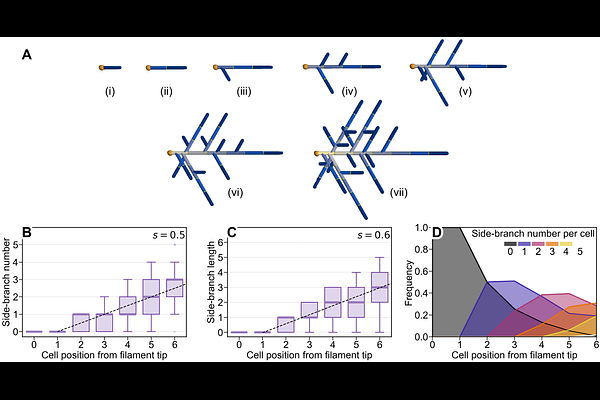
AbstractBranching forms are ubiquitous in nature and have evolved repeatedly across scales and species. An important goal of developmental biology remains to identify similarities and differences in the regulatory mechanisms underlying branching. Here, we investigate the branching filaments that form upon spore germination in mosses, using Physcomitrium patens as a model species. To identify the macroscopic rules governing filament patterning, we developed a pipeline to acquire high-resolution 3D images of whole sporelings, reconstruct filament architecture at single-cell resolution, and formalize cell organization using mathematical tree representations. Our quantitative analysis reveals that branch patterning in moss filaments can be captured by a simple probabilistic model in which subapical cells have a near-equal probability of producing - or not producing - a side-branch between successive apical cell divisions. This framework provides a quantitative basis for comparing the developmental rules driving branching morphogenesis within and beyond the plant kingdom.