Scaffold-Free Acoustic Levitation Platforms Enable Scalable Culture of Neuronal Spheroids and Assembly of Layered Cortico - Striatal Assembloids

Scaffold-Free Acoustic Levitation Platforms Enable Scalable Culture of Neuronal Spheroids and Assembly of Layered Cortico - Striatal Assembloids
Dupuis, C.; Viraye, G.; Mousset, X.; Jeger-Madiot, N.; Aider, J.-L.; Peyrin, J.-M.
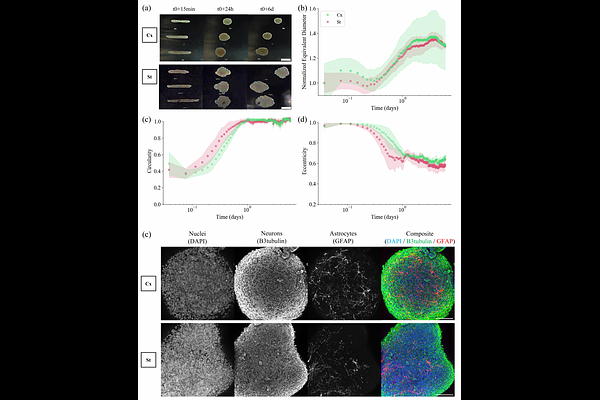
AbstractEngineering three-dimensional neuronal tissues with defined architecture and functional connectivity remains a critical challenge for applications in disease modeling, drug discovery, and regenerative medicine. Recently, a variety of fabrication methods have arisen, such as bioprinting or manual assembly of organoids, but often struggle with scalability, reproducibility, or maintaining cell viability. Here, two scaffold-free acoustic levitation bioreactors are introduced: one optimized for the culture of uniform neuronal spheroids, and another designed for the structuration of assembloids composed of distinct neuronal identities. Using acoustic standing waves, these platforms enable the contactless manipulation of cells and aggregates, facilitating the formation of highly viable functionally mature spheroids. This study shows that both striatal and cortical cell aggregates formed in acoustic levitation self-organize into spheroids within 24 hours and remain viable up to 10 days under these particular culture conditions without medium renewal. These neuro-spheroids demonstrate healthy development with increased growth and typical terminal differentiation and synaptic maturation. Moreover, concentric cortico-striatal assembloids were successfully structured and cultivated using optimized acoustofluidic chips. Offering versatile and scalable tools for engineering complex neuronal networks, acoustic levitation reveals itself as an innovative approach to 3D neuronal tissue modeling, with broad implications for bioengineering, regenerative medicine and fundamental neuroscience research.