Neurogenin-2 Reprograms Human Microglial Lineage Cells into Neurons In Vitro and in Chimeric Brains

Neurogenin-2 Reprograms Human Microglial Lineage Cells into Neurons In Vitro and in Chimeric Brains
Jin, M.; Ma, Z.; Dang, R.; Zhang, H.; Xue, H.; Finkbeiner, S.; Liu, Y.; Jiang, P.
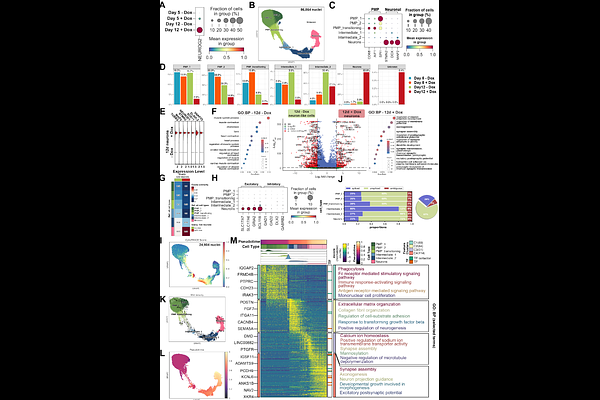
AbstractProgressive neuronal loss is a hallmark of many neurological disorders, yet the adult human brain has a limited capacity for endogenous neuronal replacement. Direct neuronal reprogramming represents an alternative strategy for generating new neurons. Microglia, the brain resident immune cells, are uniquely positioned as candidate cellular substrates due to their abundance, self-renewal capacity, high motility, and rapid recruitment to sites of injury. Here, using live-cell imaging and electrophysiological recordings, we show that human pluripotent stem cell (hPSC) derived primitive macrophage progenitors (PMPs) and their microglial derivatives exhibit neuronal reprogramming competence. Inducible expression of NEUROG2 in hPSC derived PMPs drives acquisition of neuronal morphology, sequential expression of early and mature neuronal markers, organization of synaptic proteins, and functional excitability characterized by action potential firing. Single nucleus RNA sequencing reveals a continuous, directionally ordered reprogramming trajectory marked by suppression of myeloid transcriptional programs, progression through intermediate remodeling states, and progressive activation of neuronal gene regulatory networks, consistent with a regulated lineage conversion rather than partial identity switching. Using a xenotransplantation-based human microglia chimeric brain model, we further demonstrate that inducible NEUROG2 expression reprograms donor derived human microglia toward a neuronal identity in vivo. Together, these findings establish human microglial lineage cells as a previously unexplored substrate for neuronal reprogramming, providing a conceptual framework for microglia-based strategies aimed at neuronal replacement and neural repair.