Symmetries of Pauli Noise from Lindbladian Dynamics

Symmetries of Pauli Noise from Lindbladian Dynamics
Moein Malekakhlagh, Edward H. Chen, Luke C. G. Govia, Alireza Seif
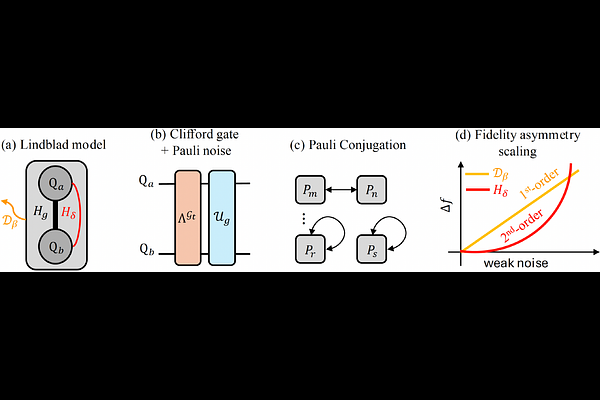
AbstractCharacterizing noise in quantum circuits is fundamentally limited by gauge degrees of freedom; certain parameters, such as the individual contributions of state preparation and measurement (SPAM) errors, are in principle unlearnable from any experiment within the gate set. Here, we show that the physical structure of realistic noise processes imposes approximate symmetry constraints on the Pauli fidelities of gate noise channels. These symmetries relate the fidelity of a Pauli $P$ and its gate-conjugate $U_g P U_g ^{\dagger}$, and can be used to fix the gauge using only knowledge of the error type and not its magnitude. Using Lindbladian perturbation theory, we analyze a broad class of Clifford gates, including $ZZ_{π/2}$, CZ, CNOT, iSWAP, and SWAP, and demonstrate that coherent errors do not induce first-order asymmetry, while only a restricted set of predominantly off-diagonal dissipative errors can break the symmetry at first order, for which we derive simple selection rules. Notably, common single-qubit noise sources such as $T_1$-relaxation and $T_{2φ}$-pure-dephasing can only cause asymmetry at second order. Leveraging these symmetries to fix the gauge enables systematic identification of SPAM errors, simplifying error characterization and mitigation. We validate our results numerically and experimentally on IBM Kingston.